Backend Developer Resume Example & Guide
A real example, 9 bullet points you can copy, salary ranges, and the specific things that get backend developer resumes rejected.
Backend resumes live or die on one question a reviewer asks silently: has this person operated a system under real load, or only built one? The difference shows in the vocabulary. Candidates who have been paged at 3am write about idempotency, backpressure, and replica lag. Candidates who have not write about CRUD endpoints.
You do not need a famous employer to demonstrate this. A service handling 200 requests a second with a documented failure mode and a runbook is more convincing than "microservices at scale" with nothing behind it.
Data is the other half. Schema decisions, migration strategy on live tables, and query optimisation are where backend engineers create and destroy the most value, and they are chronically underrepresented on resumes.
What hiring managers look for in a backend developer resume
- Throughput, latency, and availability numbers for systems you owned
- Database depth — indexing, query plans, migrations executed without downtime
- Reliability practice: on-call, incident response, runbooks, postmortems
- API design judgement — versioning, pagination, idempotency, rate limiting
- Cost awareness, which is increasingly a senior backend expectation
Backend Developer salary range
Approximate US ranges for guidance when you are setting expectations or preparing to negotiate. Actual pay varies considerably by city, employer size, and industry.
Entry
$85K – $118K
0–2 years
Mid
$118K – $160K
3–7 years
Senior
$160K – $220K
8+ years
Backend Developer resume example
A Parser Pro layout filled with sample content. Every template on NavPeer is built to parse cleanly through applicant tracking systems — no text boxes, no sidebars that scramble your work history.
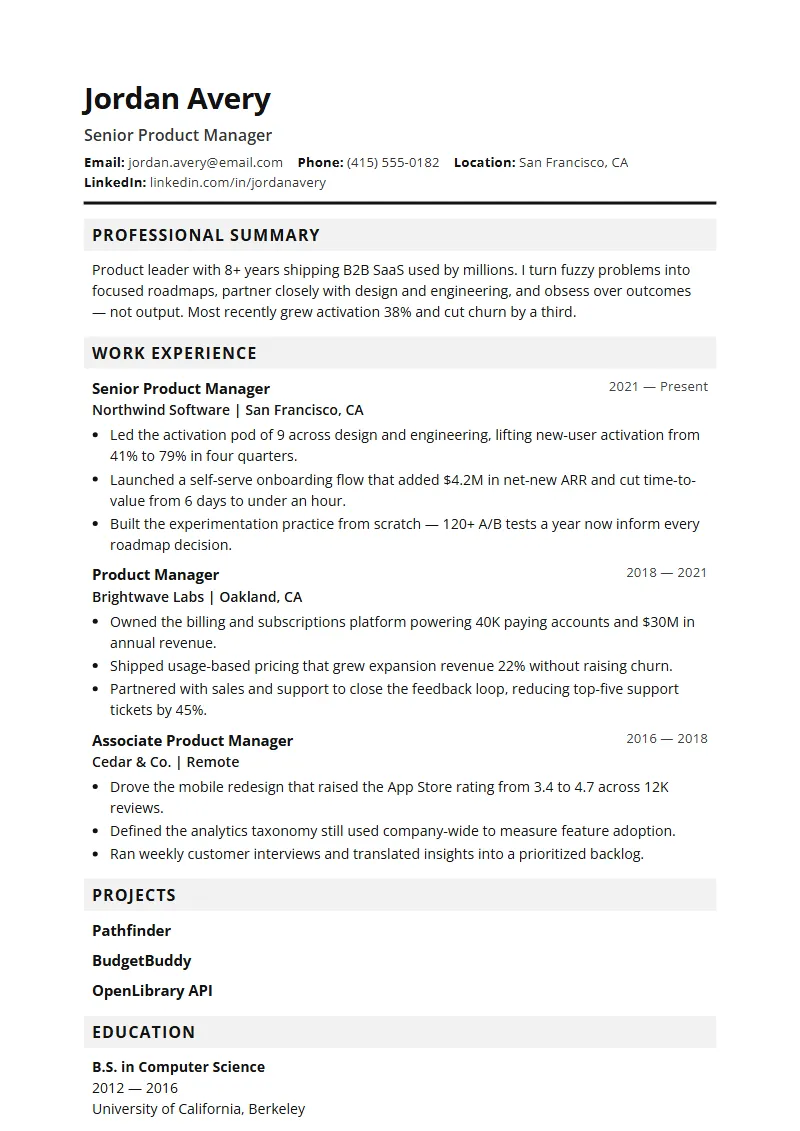
Backend Developer resume summary example
Three to four sentences at the top of the page, written in the first person without saying “I”. Rewrite it for every application — the summary is the cheapest place to show you read the job description.
9 backend developer resume bullet points you can adapt
Copy any of these and replace the specifics with your own. The numbers here are realistic examples, not claims to borrow — swap in what actually happened, because you will be asked about every figure on your resume.
- Rebuilt the order pipeline on Kafka with idempotent consumers, raising sustained throughput from 400 to 2,800 events per second and eliminating the duplicate-charge class of bug entirely.
- Cut p99 API latency from 2.3s to 410ms by adding three composite indexes and rewriting an N+1 query that was issuing 1,200 round trips per request.
- Executed a zero-downtime migration of a 900GB Postgres table to a partitioned schema using dual writes and a backfill worker, with no customer-visible impact.
- Reduced database spend 38% ($21K/month) by moving analytical reads to a replica and archiving 4 years of cold rows.
- Designed and documented the public API v2 with cursor pagination, idempotency keys, and per-tenant rate limits, now serving 340 integration partners.
- Instrumented all services with structured logging, traces, and RED metrics, cutting mean time to diagnosis from 48 minutes to 11.
- Ran incident command on 20+ severity-1 and -2 events and wrote the blameless postmortems; three resulting fixes removed the top recurring failure mode.
- Introduced a dead-letter queue with automated replay, recovering 100% of the 14,000 messages dropped during a downstream outage.
- Hardened authentication with rotating refresh tokens and per-device revocation, closing two findings from the annual security audit.
Tools and technologies to list
Write these as literal strings. An applicant tracking system configured for “PostgreSQL” will not match “Postgres”, and it certainly will not match “relational databases”.
ATS keywords for this role
Applicant tracking systems match literal strings. Work the ones that genuinely apply to you into your summary, skills section, and bullets — and never into white text or a hidden block, which every modern system detects and most employers treat as disqualifying.
Section-by-section breakdown
Quantify the system, then your change to it
Two numbers per bullet beats one: the scale of the thing, and the delta you produced. "Cut latency 40%" is weaker than "cut p99 latency 40% on an endpoint serving 12M requests a day." The first is a percentage; the second is a responsibility.
Give databases their own line in your skills block
Backend job descriptions almost always name a specific database, and ATS filters follow. Separate Databases from Languages and write the literal names — PostgreSQL, not "SQL databases."
Show reliability work explicitly
On-call participation, runbooks written, incidents commanded, and postmortems authored are all resume-worthy and rarely listed. They are the fastest way to signal that you have operated, not just built.
Core skills for this role
A human reviewer scans this section to decide whether to read the rest. Keep it to the skills you would be comfortable being interviewed on in depth.
Mistakes that sink backend developer resumes
These are the failure modes specific to this role — not general resume advice you have already read a dozen times.
- Saying "microservices" without a count, a boundary rationale, or a scale figure. It has become a word that reviewers discount automatically.
- Omitting database work because it feels unglamorous. Index and schema decisions are frequently the highest-leverage thing on a backend resume.
- Listing cloud providers as skills without naming services. "AWS" is noise; "SQS, Lambda, RDS, ElastiCache" is a match.
- Framing everything as team output. "We migrated" leaves the reviewer unable to tell what you did — use "I" implicitly by starting with your verb.
- Ignoring cost. Senior backend hiring increasingly screens for infrastructure spend awareness, and almost no resume mentions it.
Frequently asked questions
Related resume examples
Build your backend developer resume
Start from an ATS-safe template and write your real experience into it. Nothing here invents an employer, a title, or a number — the live ATS score just tells you what the job is looking for.