Cybersecurity Analyst Resume Example & Guide
A real example, 9 bullet points you can copy, salary ranges, and the specific things that get cybersecurity analyst resumes rejected.
Security resumes have a discretion problem: the most impressive things you have done are often the things you cannot describe. The solution is to write about scope, method, and outcome without naming systems or disclosing weaknesses — "reduced mean time to contain from 4 hours to 35 minutes across a 6,000-endpoint estate" says a great deal and reveals nothing exploitable.
Certifications carry unusual weight in this field. Security+ , CISSP, and GCIH are used as hard filters by a large share of employers and government contractors, so they belong in a visible section rather than buried at the bottom.
Frameworks are the other keyword layer. NIST CSF, ISO 27001, SOC 2, MITRE ATT&CK, and CIS Controls appear constantly in postings, and mapping your work to them makes your experience legible to compliance-driven organisations.
What hiring managers look for in a cybersecurity analyst resume
- Detection and response metrics — alert volume, MTTD, MTTC, false-positive rate
- Named tooling: SIEM, EDR, vulnerability management platforms
- Framework fluency: NIST, ISO 27001, SOC 2, MITRE ATT&CK
- Relevant certifications, which are frequently a hard filter
- Judgement — evidence you can prioritise risk, not just report findings
Certifications and licences for cybersecurity analyst roles
List these near the top of your resume. In this field they are eligibility requirements, not accomplishments — a recruiter cannot advance you without them.
- CompTIA Security+
- GIAC Certified Incident Handler (GCIH)
- CompTIA CySA+
- CISSP
- Certified Ethical Hacker (CEH)
Cybersecurity Analyst salary range
Approximate US ranges for guidance when you are setting expectations or preparing to negotiate. Actual pay varies considerably by city, employer size, and industry.
Entry
$70K – $98K
0–2 years
Mid
$98K – $135K
3–7 years
Senior
$135K – $180K
8+ years
Cybersecurity Analyst resume example
A Baseline layout filled with sample content. Every template on NavPeer is built to parse cleanly through applicant tracking systems — no text boxes, no sidebars that scramble your work history.
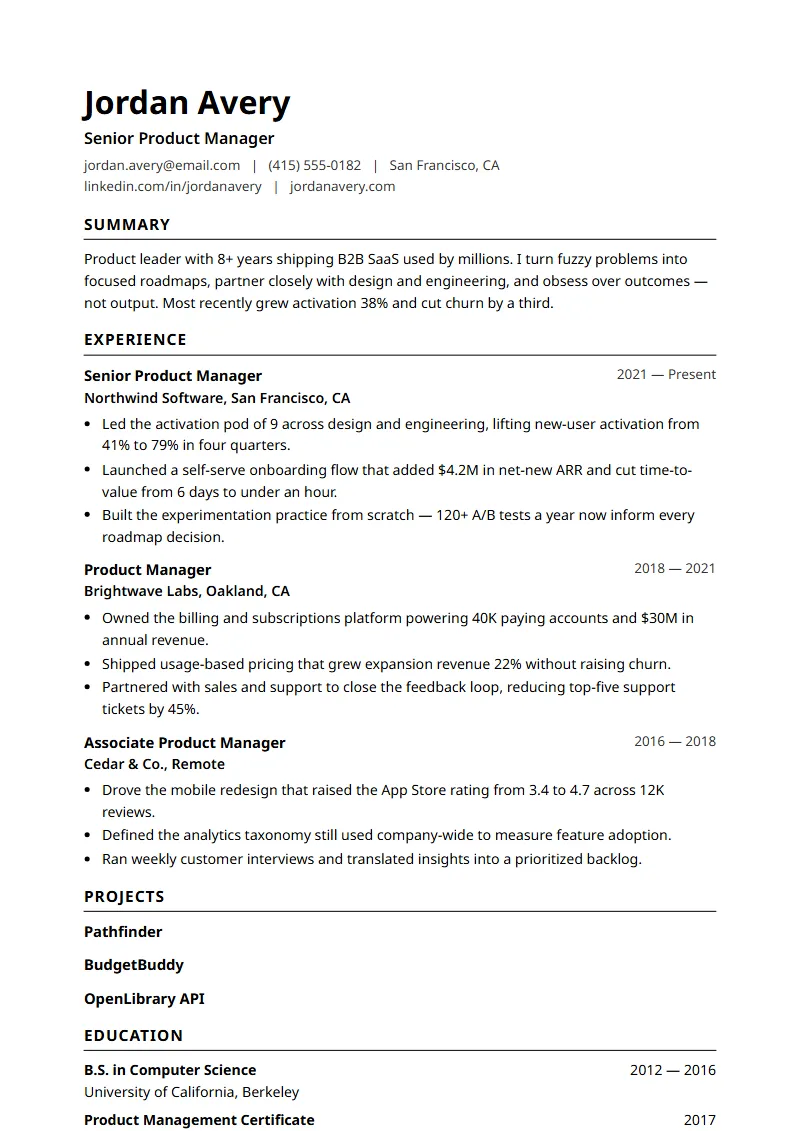
Cybersecurity Analyst resume summary example
Three to four sentences at the top of the page, written in the first person without saying “I”. Rewrite it for every application — the summary is the cheapest place to show you read the job description.
9 cybersecurity analyst resume bullet points you can adapt
Copy any of these and replace the specifics with your own. The numbers here are realistic examples, not claims to borrow — swap in what actually happened, because you will be asked about every figure on your resume.
- Reduced mean time to contain from 4 hours to 35 minutes across a 6,000-endpoint estate by rewriting triage playbooks and automating host isolation.
- Tuned SIEM detection rules to cut daily alert volume from 400 to 90 while increasing true-positive rate from 6% to 31%, ending analyst alert fatigue as a standing issue.
- Led incident response on 40+ confirmed security events including a credential-stuffing campaign contained within 20 minutes of first detection.
- Ran the vulnerability management programme across 1,200 assets, cutting critical findings older than 30 days from 180 to 11.
- Mapped detection coverage to MITRE ATT&CK and closed 14 gaps in the top-10 techniques observed in the industry threat landscape.
- Owned the evidence workstream for SOC 2 Type II, coordinating 60 controls across 5 teams and achieving a report with no exceptions.
- Built a phishing simulation and training programme that reduced click-through from 22% to 4.6% over 12 months across 900 staff.
- Deployed EDR to 100% of the endpoint estate, replacing legacy antivirus and giving the SOC process-level telemetry it previously lacked.
- Automated enrichment of alerts with threat intelligence and asset context, cutting average triage time per alert from 12 minutes to 3.
Tools and technologies to list
Write these as literal strings. An applicant tracking system configured for “PostgreSQL” will not match “Postgres”, and it certainly will not match “relational databases”.
ATS keywords for this role
Applicant tracking systems match literal strings. Work the ones that genuinely apply to you into your summary, skills section, and bullets — and never into white text or a hidden block, which every modern system detects and most employers treat as disqualifying.
Section-by-section breakdown
Put certifications high on the page
Unlike most fields, security certifications function as hard filters — many postings will not advance a candidate without one. A compact section under the summary is the right placement.
Quantify without disclosing
Describe scale, time, and volume rather than architecture or weaknesses. Employers read careless specificity as a security risk in itself, so discretion is part of what you are demonstrating.
Map work to frameworks
Attaching NIST CSF functions, ISO 27001 controls, or ATT&CK techniques to your bullets makes them instantly legible to compliance-driven organisations and hits a dense keyword layer.
Core skills for this role
A human reviewer scans this section to decide whether to read the rest. Keep it to the skills you would be comfortable being interviewed on in depth.
Mistakes that sink cybersecurity analyst resumes
These are the failure modes specific to this role — not general resume advice you have already read a dozen times.
- Naming an employer's specific vulnerabilities or architecture. It is the fastest way to fail a security screen.
- Alert counts with no outcome. "Monitored 500 alerts daily" describes a queue, not a contribution.
- Omitting certifications, or hiding them at the bottom, when they are the gate.
- Claiming red-team skills on a blue-team resume without evidence. The disciplines are screened very differently.
- Generic 'improved security posture' language, which reviewers in this field discount entirely.
Frequently asked questions
Related resume examples
Build your cybersecurity analyst resume
Start from an ATS-safe template and write your real experience into it. Nothing here invents an employer, a title, or a number — the live ATS score just tells you what the job is looking for.