Data Entry Clerk Resume Example & Guide
A real example, 8 bullet points you can copy, salary ranges, and the specific things that get data entry clerk resumes rejected.
Data entry hiring comes down to two numbers — speed and accuracy — and the second matters far more. An employer will happily take fewer records per hour in exchange for an error rate that does not create downstream cleanup work, because bad data costs several times what it costs to enter.
The way to avoid being a commodity applicant is to show what you do beyond keying: validation rules you caught, duplicates you resolved, and any automation you built. Data entry roles that survive are the ones where the person is also improving the process, and that framing moves you toward analyst and coordinator work.
What hiring managers look for in a data entry clerk resume
- Accuracy rate and how it is measured
- Throughput: records or documents processed per hour or day
- Systems: the specific database, ERP, or CRM
- Data validation and quality work beyond keying
- Confidentiality handling for sensitive records
Data Entry Clerk salary range
Approximate US ranges for guidance when you are setting expectations or preparing to negotiate. Actual pay varies considerably by city, employer size, and industry.
Entry
$31K – $38K
0–2 years
Mid
$38K – $46K
3–7 years
Senior
$46K – $56K
8+ years
Data Entry Clerk resume example
A Plain Text layout filled with sample content. Every template on NavPeer is built to parse cleanly through applicant tracking systems — no text boxes, no sidebars that scramble your work history.
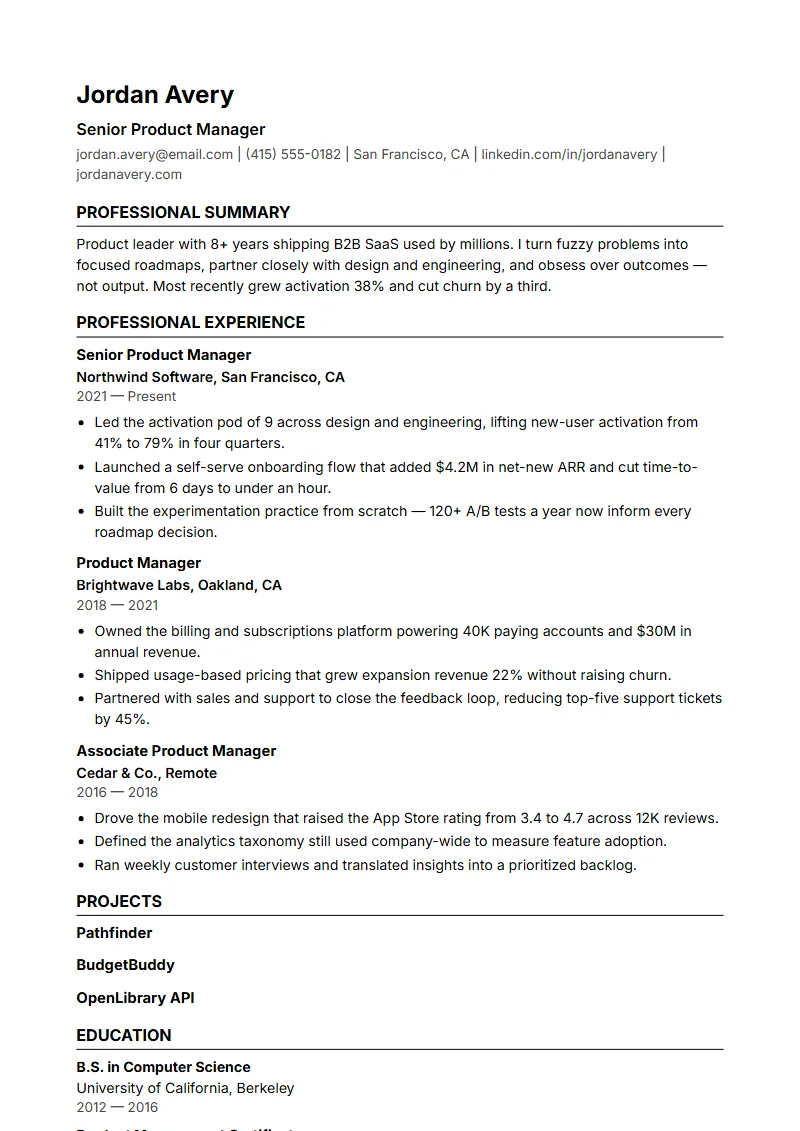
Data Entry Clerk resume summary example
Three to four sentences at the top of the page, written in the first person without saying “I”. Rewrite it for every application — the summary is the cheapest place to show you read the job description.
8 data entry clerk resume bullet points you can adapt
Copy any of these and replace the specifics with your own. The numbers here are realistic examples, not claims to borrow — swap in what actually happened, because you will be asked about every figure on your resume.
- Process 900+ records daily into the company database at a documented 99.7% accuracy rate verified through weekly QC sampling.
- Type 78 WPM with 12,000 keystrokes per hour on 10-key numeric entry, both tested rather than estimated.
- Built an Excel validation template with conditional formatting and lookup checks that cut the team's overall error rate from 2.1% to 0.9%.
- Identified and resolved 3,400 duplicate customer records during a database cleanup, restoring accurate reporting for the sales team.
- Index and scan 400+ documents weekly into the document management system with consistent naming and metadata tagging.
- Handle protected health information and financial records in compliance with HIPAA and internal confidentiality policy, with no incidents across 4 years.
- Reduced backlog from 12,000 unprocessed records to zero over 7 weeks while maintaining accuracy standards.
- Cross-check entered data against source documents in a two-pass verification process for high-value transactions.
ATS keywords for this role
Applicant tracking systems match literal strings. Work the ones that genuinely apply to you into your summary, skills section, and bullets — and never into white text or a hidden block, which every modern system detects and most employers treat as disqualifying.
Metrics worth pulling before you write
These are already measured about you. Ten minutes finding the real numbers will do more for this resume than an hour of rewording.
- Records processed per day
- Accuracy rate
- Typing speed (WPM / KPH)
- Backlog reduction
- QC audit results
Section-by-section breakdown
Lead with accuracy, then speed
Accuracy is the metric employers actually care about because errors are expensive downstream. Give the figure and say how it is measured — audited accuracy is far more credible than a claim.
Give tested typing figures
WPM and keystrokes per hour, ideally from an actual test. Vague 'fast and accurate typist' claims are ignored; a tested number is checkable and believable.
Show the quality work
Validation, deduplication, and any automation. This is what distinguishes you from a commodity applicant and points toward better-paid coordinator and analyst roles.
Core skills for this role
A human reviewer scans this section to decide whether to read the rest. Keep it to the skills you would be comfortable being interviewed on in depth.
Mistakes that sink data entry clerk resumes
These are the failure modes specific to this role — not general resume advice you have already read a dozen times.
- No accuracy figure, which is the central qualification for the role.
- Speed without accuracy, which reads as a liability rather than an asset.
- Omitting the specific systems, which are common filters.
- Ignoring confidentiality, which matters greatly in medical, financial, and legal data entry.
- Presenting yourself as purely a keyer when you have done validation or cleanup work.
Frequently asked questions
Related resume examples
Build your data entry clerk resume
Start from an ATS-safe template and write your real experience into it. Nothing here invents an employer, a title, or a number — the live ATS score just tells you what the job is looking for.