Insurance Agent Resume Example & Guide
A real example, 8 bullet points you can copy, salary ranges, and the specific things that get insurance agent resumes rejected.
Insurance resumes are production documents, and the numbers that matter are premium written, policy count, retention, and loss ratio. The first two show you can sell; the last two show that what you sold was worth having, which is what separates a durable book from a churning one.
License lines are the eligibility layer. Property and casualty, life and health, and the states you are appointed in determine what you can produce and where. Personal lines and commercial lines are also distinct markets requiring different expertise.
Retention is the quiet differentiator. A 94% retention rate over several years is powerful evidence that your book was written properly, and it is the metric agency owners care about most because acquisition is expensive.
What hiring managers look for in a insurance agent resume
- License lines, states, and appointments
- Annual premium written and policy count
- Retention rate and book persistency
- Loss ratio, for commercial and P&C roles
- Whether the book was self-generated or inherited
Certifications and licences for insurance agent roles
List these near the top of your resume. In this field they are eligibility requirements, not accomplishments — a recruiter cannot advance you without them.
- Property & Casualty producer license
- Life & Health producer license
- CPCU — Chartered Property Casualty Underwriter
- CIC — Certified Insurance Counselor
Insurance Agent salary range
Approximate US ranges for guidance when you are setting expectations or preparing to negotiate. Actual pay varies considerably by city, employer size, and industry.
Entry
$42K – $60K
0–2 years
Mid
$60K – $95K
3–7 years
Senior
$95K – $175K
8+ years
Insurance Agent resume example
A Granite layout filled with sample content. Every template on NavPeer is built to parse cleanly through applicant tracking systems — no text boxes, no sidebars that scramble your work history.
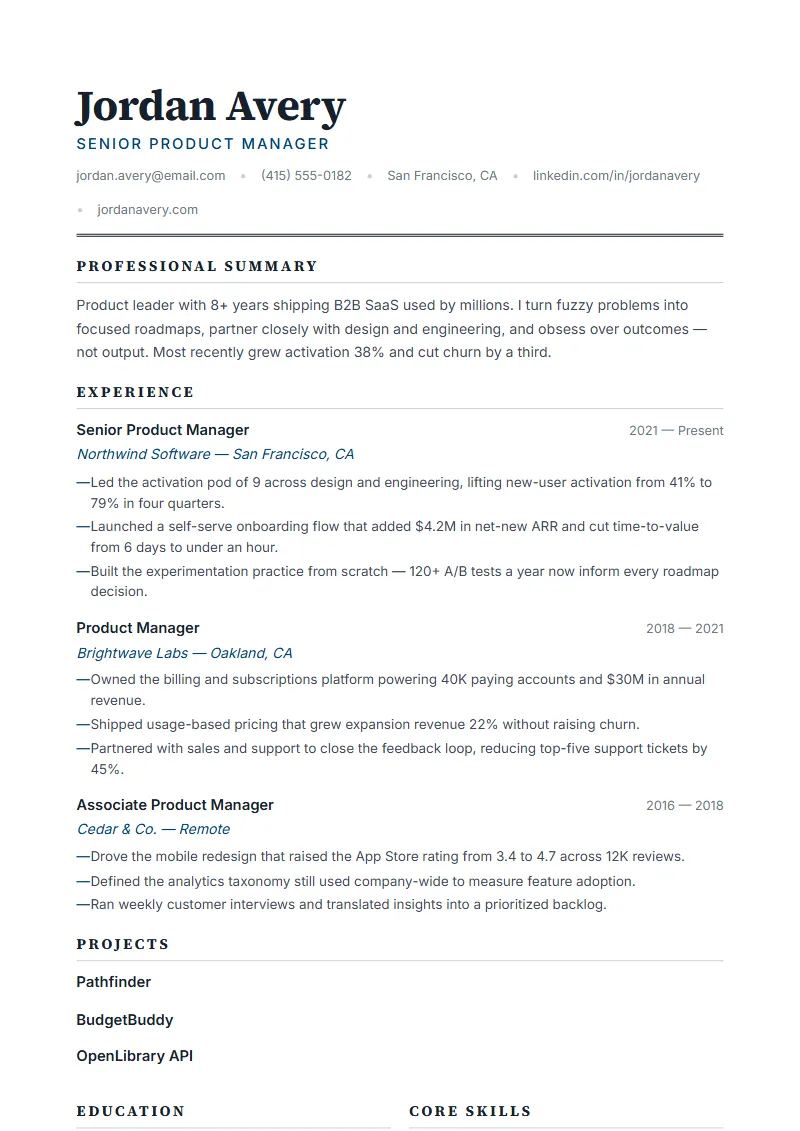
Insurance Agent resume summary example
Three to four sentences at the top of the page, written in the first person without saying “I”. Rewrite it for every application — the summary is the cheapest place to show you read the job description.
8 insurance agent resume bullet points you can adapt
Copy any of these and replace the specifics with your own. The numbers here are realistic examples, not claims to borrow — swap in what actually happened, because you will be asked about every figure on your resume.
- Write $2.8M in annual commercial premium across 240 accounts, concentrated in contractors, light manufacturing, and professional services.
- Maintain 94% client retention over four years against an agency average of 86%, driven by proactive pre-renewal reviews 90 days out.
- Hold a 41% loss ratio across the book, well inside carrier appetite and enabling access to preferred programmes for my clients.
- Built 80% of the book from self-generated referrals and centre-of-influence relationships rather than agency leads.
- Restructured coverage for a 90-vehicle fleet account, cutting their premium 22% while closing two coverage gaps their previous programme had left exposed.
- Advocate on complex claims, including a $340K property loss where I secured full settlement after an initial partial denial.
- Grew a new territory from zero to $900K in written premium within 24 months.
- Cross-sold workers' compensation and umbrella coverage into 60 existing accounts, adding $410K in premium without new client acquisition.
ATS keywords for this role
Applicant tracking systems match literal strings. Work the ones that genuinely apply to you into your summary, skills section, and bullets — and never into white text or a hidden block, which every modern system detects and most employers treat as disqualifying.
Metrics worth pulling before you write
These are already measured about you. Ten minutes finding the real numbers will do more for this resume than an hour of rewording.
- Annual written premium
- Policy or account count
- Client retention rate
- Loss ratio
- New business versus renewal split
Section-by-section breakdown
State lines and states of appointment
P&C versus L&H, personal versus commercial, and the states you are licensed in. This determines what you can write and is checked first.
Pair premium with retention and loss ratio
Premium alone can be written badly. Retention and loss ratio prove the book is profitable, which is what an agency owner is actually buying.
Be clear about book origin
Self-generated business demonstrates a repeatable skill and is worth significantly more to a hiring agency than an inherited book.
Core skills for this role
A human reviewer scans this section to decide whether to read the rest. Keep it to the skills you would be comfortable being interviewed on in depth.
Mistakes that sink insurance agent resumes
These are the failure modes specific to this role — not general resume advice you have already read a dozen times.
- No premium figures, which makes the resume unusable to a producer-hiring manager.
- Premium without retention, leaving the quality of the book unaddressed.
- Omitting the agency management system — Applied Epic and AMS360 are common filters.
- Vague licensing, which is eligibility information.
- Ignoring claims advocacy, which is a major driver of retention and client trust.
Frequently asked questions
Related resume examples
Build your insurance agent resume
Start from an ATS-safe template and write your real experience into it. Nothing here invents an employer, a title, or a number — the live ATS score just tells you what the job is looking for.