Recruiter Resume Example & Guide
A real example, 8 bullet points you can copy, salary ranges, and the specific things that get recruiter resumes rejected.
Recruiting is one of the most measurable jobs there is, and recruiting resumes are frequently among the least measured. Hires made, time-to-fill, offer acceptance rate, pipeline conversion, and first-year retention of your hires are all tracked in your ATS and all belong on the page.
Retention of your hires is the differentiating metric. Anyone can fill a role; filling it with someone still there and performing a year later is the outcome the business actually bought, and almost no recruiter claims it.
Specialisation matters. Technical, executive, healthcare, and high-volume hourly recruiting are genuinely different crafts with different sourcing channels and different candidate markets. Say which one you practise.
What hiring managers look for in a recruiter resume
- Hires made per year and the roles they were
- Time-to-fill and offer acceptance rate
- Sourcing capability — how much pipeline you generate versus receive
- First-year retention of your hires
- ATS platform and sourcing tool fluency
Recruiter salary range
Approximate US ranges for guidance when you are setting expectations or preparing to negotiate. Actual pay varies considerably by city, employer size, and industry.
Entry
$50K – $68K
0–2 years
Mid
$68K – $95K
3–7 years
Senior
$95K – $145K
8+ years
Recruiter resume example
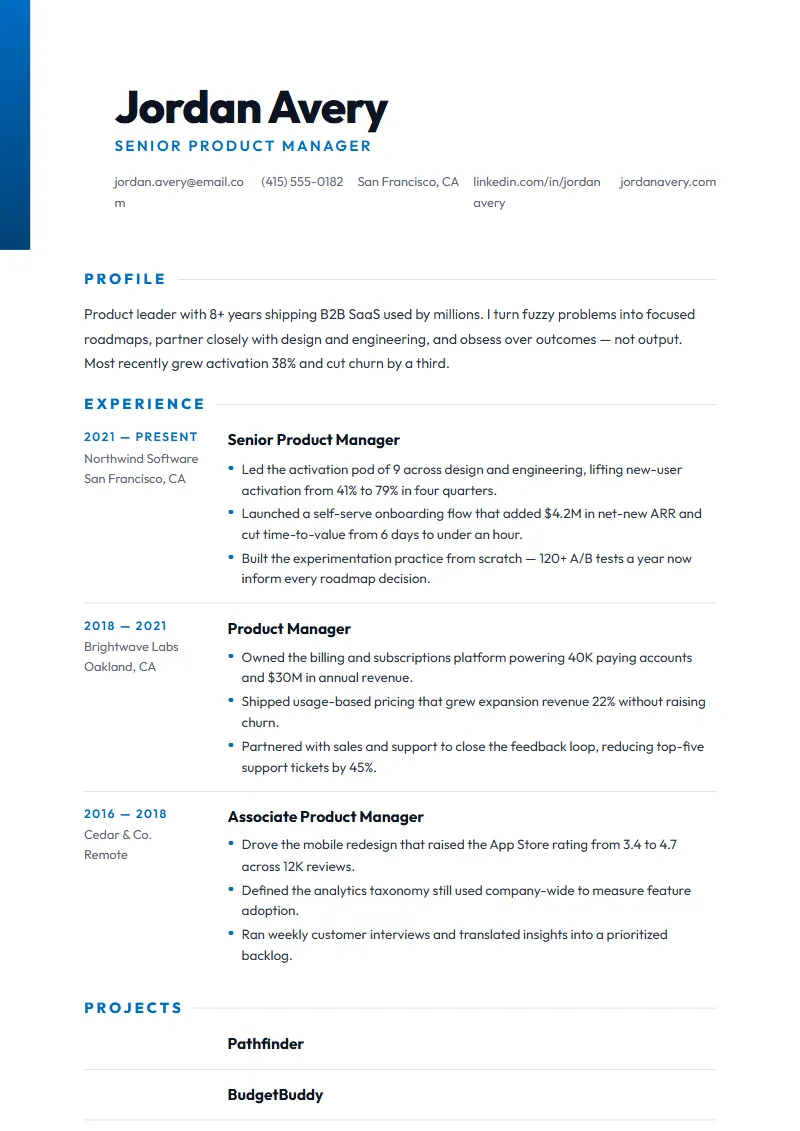
A Beacon Pro layout filled with sample content. Every template on NavPeer is built to parse cleanly through applicant tracking systems — no text boxes, no sidebars that scramble your work history.
Recruiter resume summary example
Three to four sentences at the top of the page, written in the first person without saying “I”. Rewrite it for every application — the summary is the cheapest place to show you read the job description.
8 recruiter resume bullet points you can adapt
Copy any of these and replace the specifics with your own. The numbers here are realistic examples, not claims to borrow — swap in what actually happened, because you will be asked about every figure on your resume.
- Closed 62 technical hires last year across engineering, data, and product, at an average time-to-fill of 28 days against a company average of 46.
- Maintain an 89% offer acceptance rate by aligning compensation expectations at first contact rather than at offer stage.
- Source roughly 70% of my own pipeline through Boolean search, GitHub, and referral mining, rather than relying on inbound applications.
- 91% of the hires I placed two years ago remain with the company and in good standing, against a 78% company-wide two-year retention rate.
- Rebuilt the interview process for engineering with structured scorecards and a work-sample stage, cutting hiring manager time per hire from 11 hours to 6.
- Raised the share of underrepresented candidates in engineering pipelines from 14% to 31% by changing sourcing channels and rewriting job descriptions, with hiring bar unchanged.
- Ran the intern-to-full-time conversion programme, converting 18 of 22 interns and creating the cheapest hiring channel the company had.
- Partnered with 12 hiring managers on role definition, repeatedly narrowing over-broad requirements that had left roles open for months.
ATS keywords for this role
Applicant tracking systems match literal strings. Work the ones that genuinely apply to you into your summary, skills section, and bullets — and never into white text or a hidden block, which every modern system detects and most employers treat as disqualifying.
Metrics worth pulling before you write
These are already measured about you. Ten minutes finding the real numbers will do more for this resume than an hour of rewording.
- Hires per year
- Average time to fill
- Offer acceptance rate
- Sourced versus inbound pipeline
- First-year retention of hires
Section-by-section breakdown
Lead with your numbers
Hires, time-to-fill, and acceptance rate in the summary. Every one of these is in your ATS and recruiting leaders screen on them, so their absence is conspicuous.
Claim retention of your hires
First-year or two-year retention of people you placed is the quality metric behind the volume metric, and almost nobody puts it on a resume.
Show sourcing versus inbound
Recruiters who generate pipeline are worth substantially more than those who process applicants. Make the split explicit with a percentage.
Core skills for this role
A human reviewer scans this section to decide whether to read the rest. Keep it to the skills you would be comfortable being interviewed on in depth.
Mistakes that sink recruiter resumes
These are the failure modes specific to this role — not general resume advice you have already read a dozen times.
- No metrics, in the most metric-rich role in HR.
- Requisition counts without fill rates or quality measures.
- Omitting the ATS, which is a common filter and a real ramp cost.
- Describing coordination when applying for full-cycle roles — be precise about which parts you own.
- Ignoring hiring manager partnership, which is where most recruiting actually succeeds or fails.
Frequently asked questions
Related resume examples
Build your recruiter resume
Start from an ATS-safe template and write your real experience into it. Nothing here invents an employer, a title, or a number — the live ATS score just tells you what the job is looking for.