Research Scientist Resume Example & Guide
A real example, 9 bullet points you can copy, salary ranges, and the specific things that get research scientist resumes rejected.
The hardest part of a research scientist job search is that academia and industry read the same document in opposite directions. An academic search committee wants a CV: complete publication list, funding history, teaching, service, and every conference poster since your PhD. An industry R&D team wants a two-page resume showing that you can pick a problem, run it to a decision, and hand something usable to a team. Sending an eight-page CV to a biotech hiring manager is the single most common self-inflicted rejection in this field.
Industry hiring cares about a specific and slightly uncomfortable thing: what happened to your research. Not what you investigated — what shipped, transferred, patented, or got killed on your recommendation. A scientist who can say 'ran the stability study that killed a formulation before it entered Phase I, saving roughly 18 months' is demonstrating exactly the judgement the role is being hired for. Publications prove rigour; decisions prove usefulness.
Technique depth is the third screen and the most literal. Hiring managers filter on named methods — CRISPR-Cas9, cryo-EM, LC-MS/MS, scRNA-seq, patch clamp, DFT, molecular dynamics — because a lab has instruments and needs someone who can run them by week two. List the techniques you own independently and separate them from ones you have only assisted on. Overstating here surfaces in the first technical interview.
What hiring managers look for in a research scientist resume
- Techniques you can run independently, named specifically, with instruments and platforms
- Research outcomes: publications, patents, transferred processes, or decisions your work drove
- Evidence of owning a project end to end — design, execution, analysis, and recommendation
- Statistical and computational fluency, with the languages and packages you actually use
- Collaboration and mentorship, plus grant or funding involvement where relevant
Research Scientist salary range
Approximate US ranges for guidance when you are setting expectations or preparing to negotiate. Actual pay varies considerably by city, employer size, and industry.
Entry
$82K – $105K
0–2 years
Mid
$105K – $140K
3–7 years
Senior
$140K – $195K
8+ years
Research Scientist resume example
A Curator layout filled with sample content. Every template on NavPeer is built to parse cleanly through applicant tracking systems — no text boxes, no sidebars that scramble your work history.
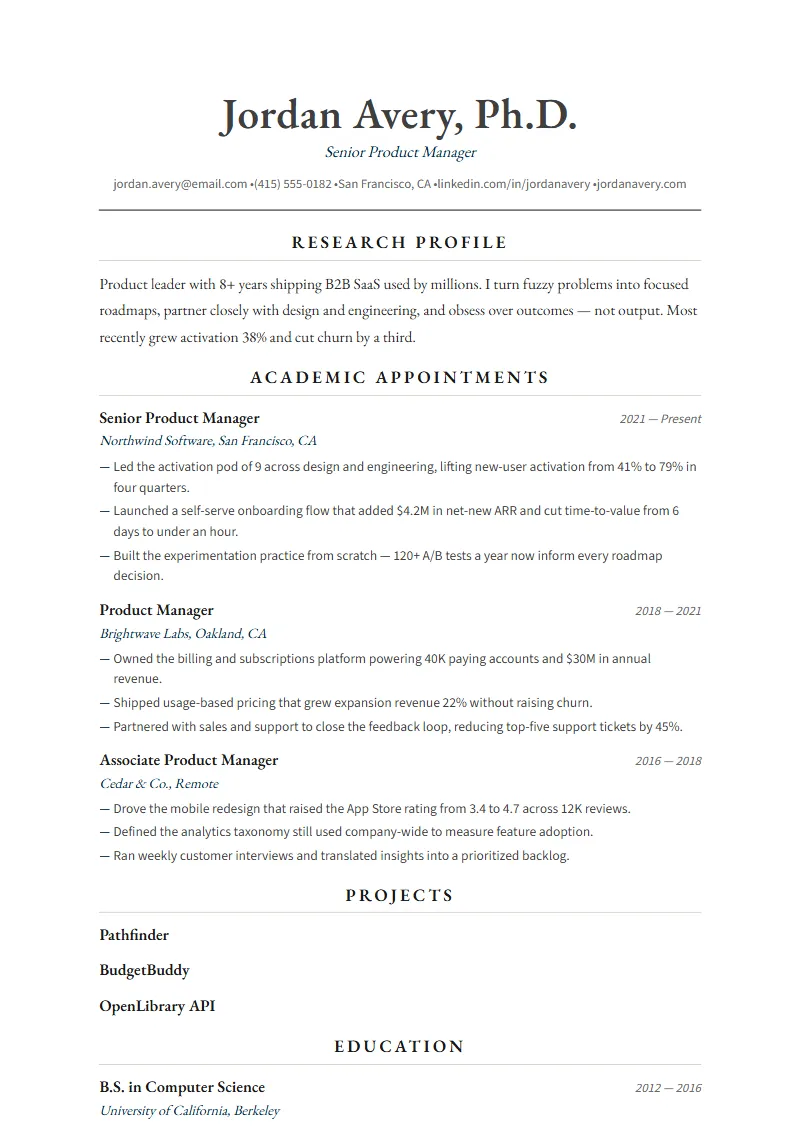
Research Scientist resume summary example
Three to four sentences at the top of the page, written in the first person without saying “I”. Rewrite it for every application — the summary is the cheapest place to show you read the job description.
9 research scientist resume bullet points you can adapt
Copy any of these and replace the specifics with your own. The numbers here are realistic examples, not claims to borrow — swap in what actually happened, because you will be asked about every figure on your resume.
- Designed and validated a 14-colour flow cytometry panel for tumour-infiltrating lymphocyte profiling, now the standard assay across three discovery programmes.
- Led a CRISPR-Cas9 knockout screen across 18,000 genes, identifying 4 candidate resistance targets, 2 of which advanced to lead optimisation.
- Ran the formulation stability study that recommended terminating a candidate before Phase I entry, avoiding an estimated 18 months and $2M of development spend.
- Published 11 peer-reviewed papers including 4 first-author articles in journals with impact factor above 8; work cited roughly 340 times to date.
- Secured $420K in competitive funding as co-investigator across two NIH R01 supplements and one internal innovation grant.
- Built a Python analysis pipeline for single-cell RNA-seq that cut standard processing time from 3 days to under 4 hours and is now used by 9 colleagues.
- Co-invented and filed a patent on a novel conjugation chemistry, issued in 2025 and licensed into an ongoing partnership.
- Mentored 6 graduate students and 3 research associates, 4 of whom published first-author papers from projects I designed and supervised.
- Transferred a validated bioassay from research to the QC organisation, authoring the protocol and training analysts through GLP qualification.
Tools and technologies to list
Write these as literal strings. An applicant tracking system configured for “PostgreSQL” will not match “Postgres”, and it certainly will not match “relational databases”.
ATS keywords for this role
Applicant tracking systems match literal strings. Work the ones that genuinely apply to you into your summary, skills section, and bullets — and never into white text or a hidden block, which every modern system detects and most employers treat as disqualifying.
Section-by-section breakdown
Decide whether you need a resume or a CV
Academic and national-lab positions expect a full CV with complete publications, funding, teaching, and service. Industry R&D expects two pages. Maintain both documents deliberately rather than trying to make one serve both audiences — the compromise version underperforms with everyone.
Separate independent techniques from assisted ones
Split your methods into what you run independently and what you have supported. Hiring managers need someone productive on their instruments quickly, and an honest split builds far more confidence than a long undifferentiated list that collapses under technical questioning.
Report outcomes, not just activity
For industry roles especially, attach a consequence to your projects — advanced, terminated, transferred, patented, licensed, adopted. 'Investigated X' describes effort. 'Recommended terminating X and the programme closed' describes judgement, which is what a senior scientist is paid for.
What your portfolio needs to do
In this field the portfolio is the hiring instrument and the resume is the supporting document. Put the link in your header — not the footer, not a section at the bottom — and make sure it loads fast on a phone.
- Curate per application. Six to ten pieces chosen for this employer beats a complete archive every time.
- Give every piece context: the brief, the constraint, and what happened afterwards.
- Check every link before you send. Dead portfolio links are read as carelessness about your own work.
- If the work is under NDA, say so and include the password rather than making the reviewer ask.
Core skills for this role
A human reviewer scans this section to decide whether to read the rest. Keep it to the skills you would be comfortable being interviewed on in depth.
Mistakes that sink research scientist resumes
These are the failure modes specific to this role — not general resume advice you have already read a dozen times.
- Sending an academic CV to an industry role. Eight pages of conference posters signals a poor read of the audience before a word is assessed.
- Listing techniques without distinguishing independent capability from assisted exposure — a gap that always surfaces in the technical screen.
- Describing projects with no outcome, leaving a reader unable to tell finished work from work that quietly stalled.
- Omitting computational and statistical tooling, which is now a hard filter in most biotech and materials postings.
- Padding the publication list with every abstract and poster. For industry, list selected publications and a total count instead.
Frequently asked questions
Related resume examples
Build your research scientist resume
Start from an ATS-safe template and write your real experience into it. Nothing here invents an employer, a title, or a number — the live ATS score just tells you what the job is looking for.