Career Change Resume Example & Guide
A real example, 8 bullet points you can copy, salary ranges, and the specific things that get career change resumes rejected.
A career change resume has one job: make the hiring manager stop asking "why is this person applying?" within the first five seconds. That means the summary must state the target role explicitly and connect your background to it, rather than leaving the reader to work out the relevance themselves.
The instinct to hide the old career is wrong. Your years of experience are an asset — a nurse moving into healthcare software understands clinical workflow better than any bootcamp graduate; a teacher moving into corporate training has managed a room for a decade. The task is translation, not concealment.
The other essential ingredient is proof of commitment. A certification, a portfolio project, a course completed, or volunteer work in the new field converts "I want to change" into "I have already started", which is a completely different proposition.
What hiring managers look for in a career change resume
- An immediate, explicit statement of the target role
- Transferable skills translated into the new field's vocabulary
- Concrete evidence of commitment — certification, projects, coursework
- Achievements from the previous career reframed for relevance
- A credible explanation of why this change, at this point
Career Change salary range
Approximate US ranges for guidance when you are setting expectations or preparing to negotiate. Actual pay varies considerably by city, employer size, and industry.
Entry
$45K – $65K
0–2 years
Mid
$60K – $90K
3–7 years
Senior
$80K – $120K
8+ years
Career Change resume example
A Openroad layout filled with sample content. Every template on NavPeer is built to parse cleanly through applicant tracking systems — no text boxes, no sidebars that scramble your work history.
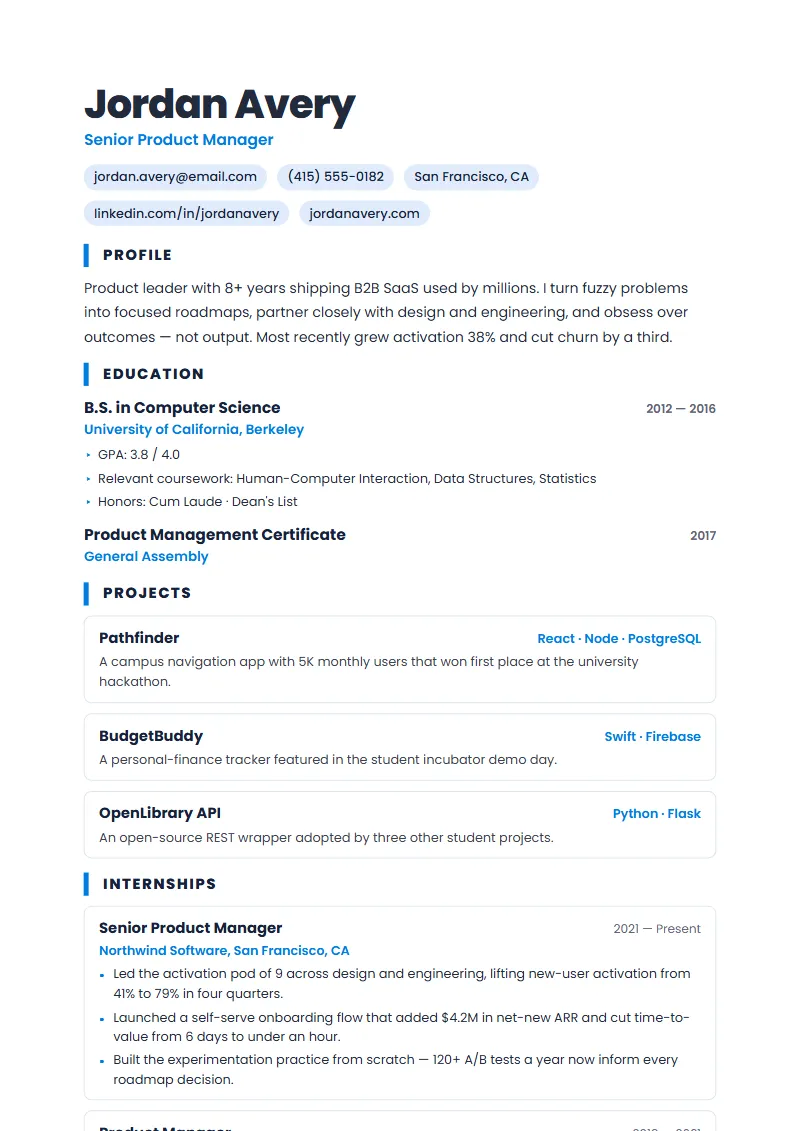
Career Change resume summary example
Three to four sentences at the top of the page, written in the first person without saying “I”. Rewrite it for every application — the summary is the cheapest place to show you read the job description.
8 career change resume bullet points you can adapt
Copy any of these and replace the specifics with your own. The numbers here are realistic examples, not claims to borrow — swap in what actually happened, because you will be asked about every figure on your resume.
- Led the clinical workstream for an EHR implementation across a 32-bed unit, translating between the vendor's implementation team and 40 nurses who had to use the result.
- Redesigned the unit's medication reconciliation workflow, cutting documentation time 22 minutes per shift and reducing reconciliation errors 40%.
- Completed a product management certification and built two case studies analysing clinical software failure modes, both published and reviewed by practising product managers.
- Trained 30 staff on a new documentation system, producing the quick-reference guide the department still uses.
- Chaired a shared-governance committee of 12 for two years, taking proposals through to implementation across three units.
- Analysed two years of unit incident data to identify the three recurring causes, presenting findings to hospital leadership and driving a protocol change.
- Managed competing priorities for 5–6 patients per shift under time pressure, with escalation decisions made independently.
- Volunteer as a user researcher for a health-tech startup, running 14 interviews with clinicians and delivering a synthesis the team used to reprioritise its roadmap.
ATS keywords for this role
Applicant tracking systems match literal strings. Work the ones that genuinely apply to you into your summary, skills section, and bullets — and never into white text or a hidden block, which every modern system detects and most employers treat as disqualifying.
Section-by-section breakdown
Name the target role in the first line
"Registered nurse of 9 years moving into clinical product management" answers the reviewer's question before they ask it. Without this, the resume reads as a misdirected application.
Translate, do not conceal
Rewrite your past achievements in the target field's vocabulary — patients become users, shift coordination becomes stakeholder management, protocol change becomes process improvement. The substance is real; only the language needs changing.
Show you have already started
A certification, portfolio project, course, or volunteer engagement in the new field. This is the difference between an aspiration and a transition already underway, and it is what makes the risk feel manageable to a hiring manager.
Core skills for this role
A human reviewer scans this section to decide whether to read the rest. Keep it to the skills you would be comfortable being interviewed on in depth.
Mistakes that sink career change resumes
These are the failure modes specific to this role — not general resume advice you have already read a dozen times.
- Hiding or minimising the previous career, which creates an unexplained gap and wastes your actual advantage.
- A functional resume format that omits dates. Recruiters read it as concealment and many ATS parsers handle it badly.
- Leaving the connection implicit and expecting the reader to make it themselves. They will not; they have other resumes.
- Applying with no evidence of commitment to the new field.
- Apologising for the change in the summary. Frame it as an asset, because it usually is.
Frequently asked questions
Related resume examples
Build your career change resume
Start from an ATS-safe template and write your real experience into it. Nothing here invents an employer, a title, or a number — the live ATS score just tells you what the job is looking for.