Returning to Work After a Career Break Resume Example & Guide
A real example, 8 bullet points you can copy, salary ranges, and the specific things that get returning to work after a career break resumes rejected.
The instinct when returning after a break is to hide the gap, and it is the wrong instinct. Recruiters spot unexplained gaps immediately and fill them with worse assumptions than the truth. A single line — "Career break, 2022–2025, full-time caregiving" — closes the question in six words and moves the conversation on.
Career breaks are considerably more normalised than they were, and many large employers now run formal returnship programmes specifically for people in this position. The gap is a fact to be stated, not a flaw to be managed.
What matters far more than the gap is currency. Evidence that your skills are up to date — a refreshed certification, a recent course, freelance work, or volunteering that used professional skills — addresses the only legitimate concern a hiring manager has.
What hiring managers look for in a returning to work after a career break resume
- The gap stated plainly, with a brief reason
- Evidence of current skills — recent training, certification, or project work
- Strong pre-break achievements, still quantified
- Any professional activity during the break, including unpaid
- Clear intent about the role you are returning to
Returning to Work After a Career Break salary range
Approximate US ranges for guidance when you are setting expectations or preparing to negotiate. Actual pay varies considerably by city, employer size, and industry.
Entry
$45K – $62K
0–2 years
Mid
$62K – $88K
3–7 years
Senior
$85K – $125K
8+ years
Returning to Work After a Career Break resume example
A Openroad layout filled with sample content. Every template on NavPeer is built to parse cleanly through applicant tracking systems — no text boxes, no sidebars that scramble your work history.
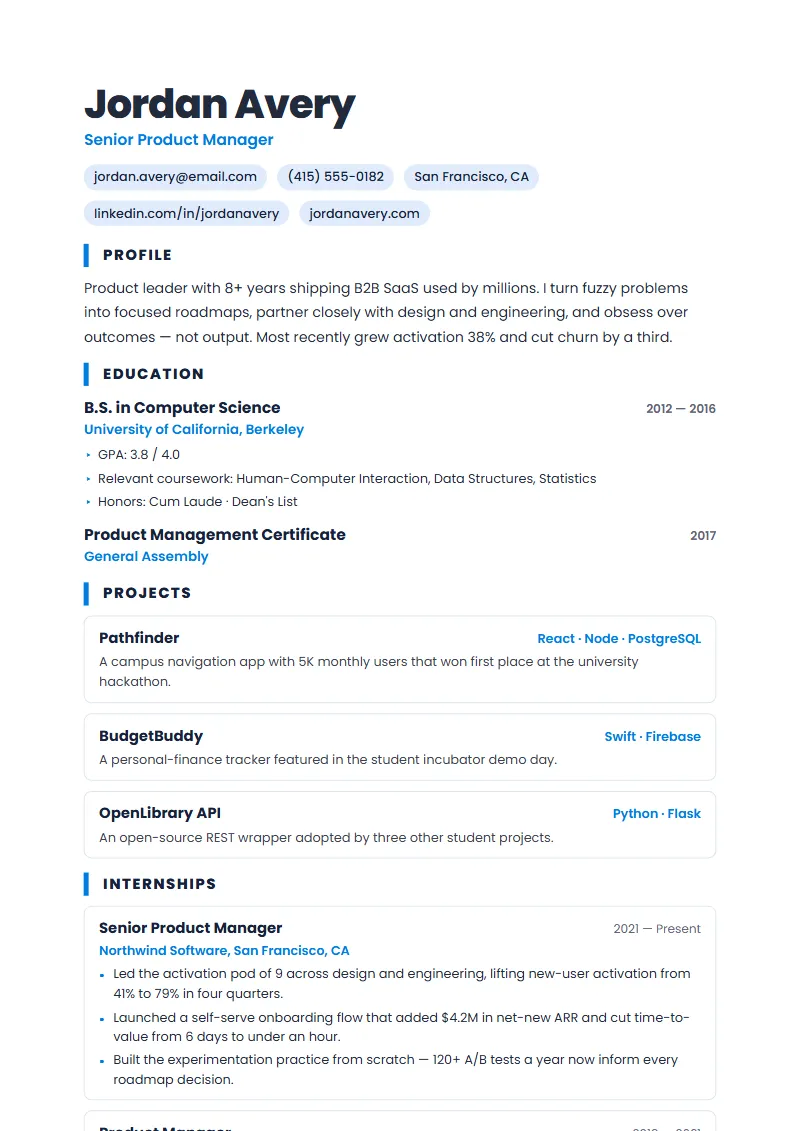
Returning to Work After a Career Break resume summary example
Three to four sentences at the top of the page, written in the first person without saying “I”. Rewrite it for every application — the summary is the cheapest place to show you read the job description.
8 returning to work after a career break resume bullet points you can adapt
Copy any of these and replace the specifics with your own. The numbers here are realistic examples, not claims to borrow — swap in what actually happened, because you will be asked about every figure on your resume.
- Career break, 2022–2025 — full-time family caregiving. Maintained professional currency through certification and freelance work throughout.
- Completed HubSpot Marketing Software and Google Analytics 4 certifications during the break, specifically to close the gap created by attribution and privacy changes since 2022.
- Provided freelance marketing support to 2 nonprofit organisations during the break, rebuilding one's email programme and lifting its donation conversion rate 34%.
- Prior to the break: managed a $1.2M marketing budget and a team of 4 for a $40M B2B business, growing marketing-sourced pipeline 62% over three years.
- Built and ran the demand generation programme that took inbound lead volume from 180 to 640 monthly at a 41% lower cost per lead.
- Served on a school board committee during the break, managing a $200K budget and coordinating across 9 stakeholders.
- Led the rebrand and website rebuild for a previous employer, coordinating agency, internal stakeholders, and a 5-month timeline.
- Volunteered as a mentor for two early-career marketers throughout the break, staying engaged with the field's current practice.
ATS keywords for this role
Applicant tracking systems match literal strings. Work the ones that genuinely apply to you into your summary, skills section, and bullets — and never into white text or a hidden block, which every modern system detects and most employers treat as disqualifying.
Section-by-section breakdown
State the gap as a line item
Give it dates and one short reason, formatted like any other entry. Six words removes the question entirely, and every recruiter would rather read that than guess.
Prove currency deliberately
A recent certification, course, or piece of freelance work directly addresses the one real concern — that your skills may have drifted. This is the highest-value thing you can do before applying.
Keep pre-break achievements fully quantified
Your prior experience did not become less real. Present those achievements with the same numbers and confidence you would have used the week before you left.
Core skills for this role
A human reviewer scans this section to decide whether to read the rest. Keep it to the skills you would be comfortable being interviewed on in depth.
Mistakes that sink returning to work after a career break resumes
These are the failure modes specific to this role — not general resume advice you have already read a dozen times.
- Leaving the gap unexplained, which invites worse assumptions than the truth.
- Over-explaining or apologising for the break in the summary. One line is the correct length.
- Omitting volunteer, freelance, or community work done during the break, which is often genuinely relevant.
- Presenting outdated technical skills without acknowledging what has changed in the field.
- Using a functional format to obscure dates, which recruiters read as evasion.
Frequently asked questions
Related resume examples
Build your returning to work after a career break resume
Start from an ATS-safe template and write your real experience into it. Nothing here invents an employer, a title, or a number — the live ATS score just tells you what the job is looking for.