Content Writer Resume Example & Guide
A real example, 8 bullet points you can copy, salary ranges, and the specific things that get content writer resumes rejected.
Writing resumes need to prove two separate things: that you write well, and that your writing produced results. The portfolio proves the first, so the resume's job is entirely the second — traffic, conversions, rankings, leads, and pipeline attributable to what you published.
Volume and cadence matter more than most writers think. Publishing 8 well-researched pieces a month sustainably is a genuinely different capability from producing one showcase article a quarter, and employers hiring content roles are usually buying the first.
In an environment where drafting is cheap, the durable value has moved to research, subject-matter interviewing, editorial judgement, and distribution. Resumes that emphasise those are better positioned than ones that emphasise word count.
What hiring managers look for in a content writer resume
- Portfolio links that load, with published work under your byline
- Traffic, ranking, or conversion results from specific pieces
- Publishing cadence and volume sustained over time
- Subject-matter depth in their industry
- SEO literacy and distribution understanding
Content Writer salary range
Approximate US ranges for guidance when you are setting expectations or preparing to negotiate. Actual pay varies considerably by city, employer size, and industry.
Entry
$45K – $62K
0–2 years
Mid
$62K – $85K
3–7 years
Senior
$85K – $120K
8+ years
Content Writer resume example
A Vista layout filled with sample content. Every template on NavPeer is built to parse cleanly through applicant tracking systems — no text boxes, no sidebars that scramble your work history.
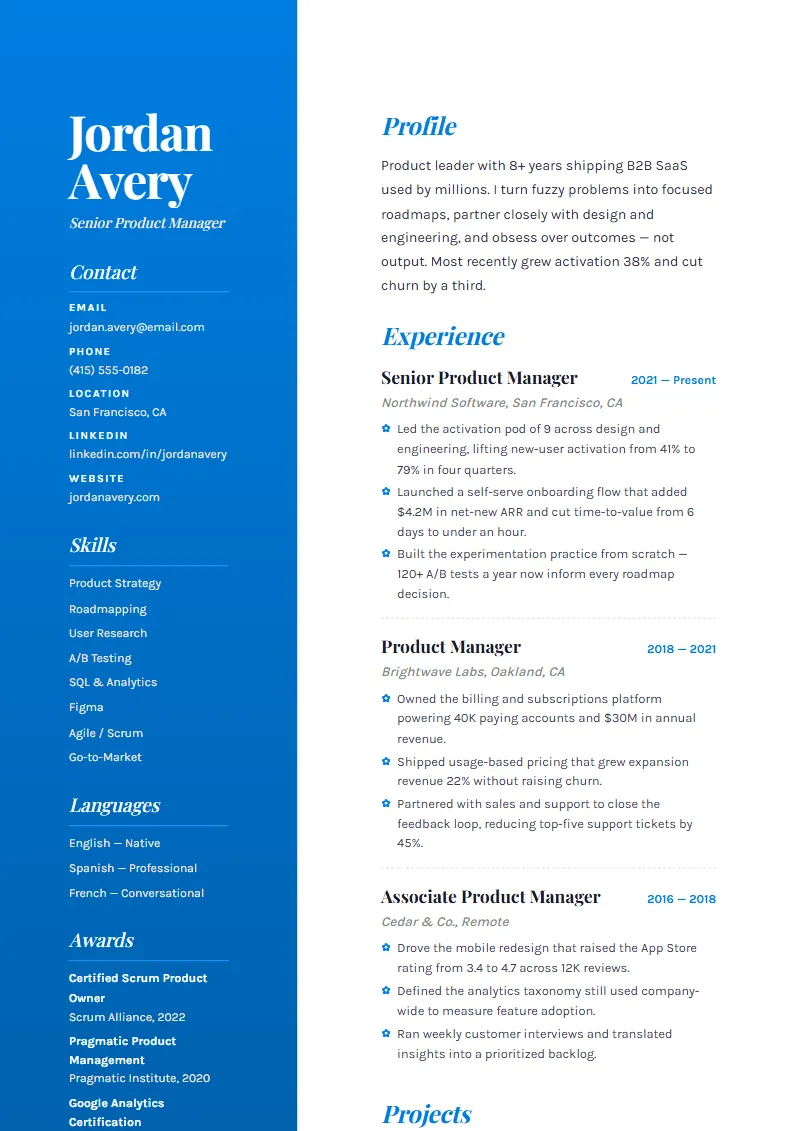
Content Writer resume summary example
Three to four sentences at the top of the page, written in the first person without saying “I”. Rewrite it for every application — the summary is the cheapest place to show you read the job description.
8 content writer resume bullet points you can adapt
Copy any of these and replace the specifics with your own. The numbers here are realistic examples, not claims to borrow — swap in what actually happened, because you will be asked about every figure on your resume.
- Publish 8–10 long-form researched pieces monthly, building a library that now drives 180K monthly organic sessions and roughly 30% of inbound demo requests.
- Wrote the pillar guide that ranks first for a 14K-monthly-volume commercial keyword and has generated an estimated $840K in attributable pipeline since publication.
- Grew blog organic traffic from 22K to 180K monthly sessions over 20 months through a topic cluster strategy I proposed and then executed.
- Interview 4–6 practitioners and internal subject-matter experts monthly, producing original insight rather than paraphrasing what already ranks.
- Rewrote 40 underperforming legacy posts, lifting their combined organic traffic 310% without publishing anything new.
- Wrote conversion copy for 12 landing pages, with A/B testing showing an average 23% lift over the previous versions.
- Built and maintain the editorial calendar and style guide used by 3 staff writers and 6 freelancers, cutting editing time per piece roughly in half.
- Produced 14 customer case studies through direct interviews, now the most-used assets in the sales team's deal cycle.
ATS keywords for this role
Applicant tracking systems match literal strings. Work the ones that genuinely apply to you into your summary, skills section, and bullets — and never into white text or a hidden block, which every modern system detects and most employers treat as disqualifying.
Metrics worth pulling before you write
These are already measured about you. Ten minutes finding the real numbers will do more for this resume than an hour of rewording.
- Organic sessions from your content
- Pieces published per month
- Keyword rankings achieved
- Conversion rate on landing copy
- Pipeline attributable to content
Section-by-section breakdown
Link your portfolio in the header
Three to five pieces showing range, with live URLs. Reviewers will read the first two paragraphs of one of them, so lead with your strongest opening rather than your most prestigious publication.
Attach results to specific pieces
"Wrote the guide that ranks first for [keyword] and drives X sessions monthly" is enormously stronger than a description of your writing style.
State your cadence
Pieces per month at a stated depth. Sustainable volume is what content teams are actually buying and it is rarely stated on writer resumes.
What your portfolio needs to do
In this field the portfolio is the hiring instrument and the resume is the supporting document. Put the link in your header — not the footer, not a section at the bottom — and make sure it loads fast on a phone.
- Curate per application. Six to ten pieces chosen for this employer beats a complete archive every time.
- Give every piece context: the brief, the constraint, and what happened afterwards.
- Check every link before you send. Dead portfolio links are read as carelessness about your own work.
- If the work is under NDA, say so and include the password rather than making the reviewer ask.
Core skills for this role
A human reviewer scans this section to decide whether to read the rest. Keep it to the skills you would be comfortable being interviewed on in depth.
Mistakes that sink content writer resumes
These are the failure modes specific to this role — not general resume advice you have already read a dozen times.
- No portfolio links, in a field where the work product is public and verification takes seconds.
- Describing writing quality subjectively rather than showing outcomes.
- Omitting SEO literacy for content marketing roles, where it is close to required.
- Listing word counts, which measures effort rather than value.
- A generic portfolio for a specialised role — send fintech samples to fintech employers.
Frequently asked questions
Related resume examples
Build your content writer resume
Start from an ATS-safe template and write your real experience into it. Nothing here invents an employer, a title, or a number — the live ATS score just tells you what the job is looking for.