Interior Designer Resume Example & Guide
A real example, 8 bullet points you can copy, salary ranges, and the specific things that get interior designer resumes rejected.
Interior design resumes need to establish sector immediately: residential, commercial, hospitality, and healthcare interiors are different disciplines with different codes, budgets, and procurement realities. A hospitality portfolio does not read as qualification for a healthcare project.
Project detail carries the resume — square footage, budget, scope, and your specific role. Whether you led the design, managed the FF&E procurement, or produced the construction documentation are very different contributions, and firms need to know which you did.
What hiring managers look for in a interior designer resume
- Sector experience matching their project pipeline
- Project scale — square footage and budget
- Documentation capability and code fluency (ADA, egress, building code)
- FF&E specification and procurement experience
- Software: Revit, AutoCAD, SketchUp, and rendering tools
Certifications and licences for interior designer roles
List these near the top of your resume. In this field they are eligibility requirements, not accomplishments — a recruiter cannot advance you without them.
- NCIDQ Certification
- State interior design registration
- LEED AP ID+C
- WELL AP
Interior Designer salary range
Approximate US ranges for guidance when you are setting expectations or preparing to negotiate. Actual pay varies considerably by city, employer size, and industry.
Entry
$48K – $62K
0–2 years
Mid
$62K – $88K
3–7 years
Senior
$88K – $130K
8+ years
Interior Designer resume example
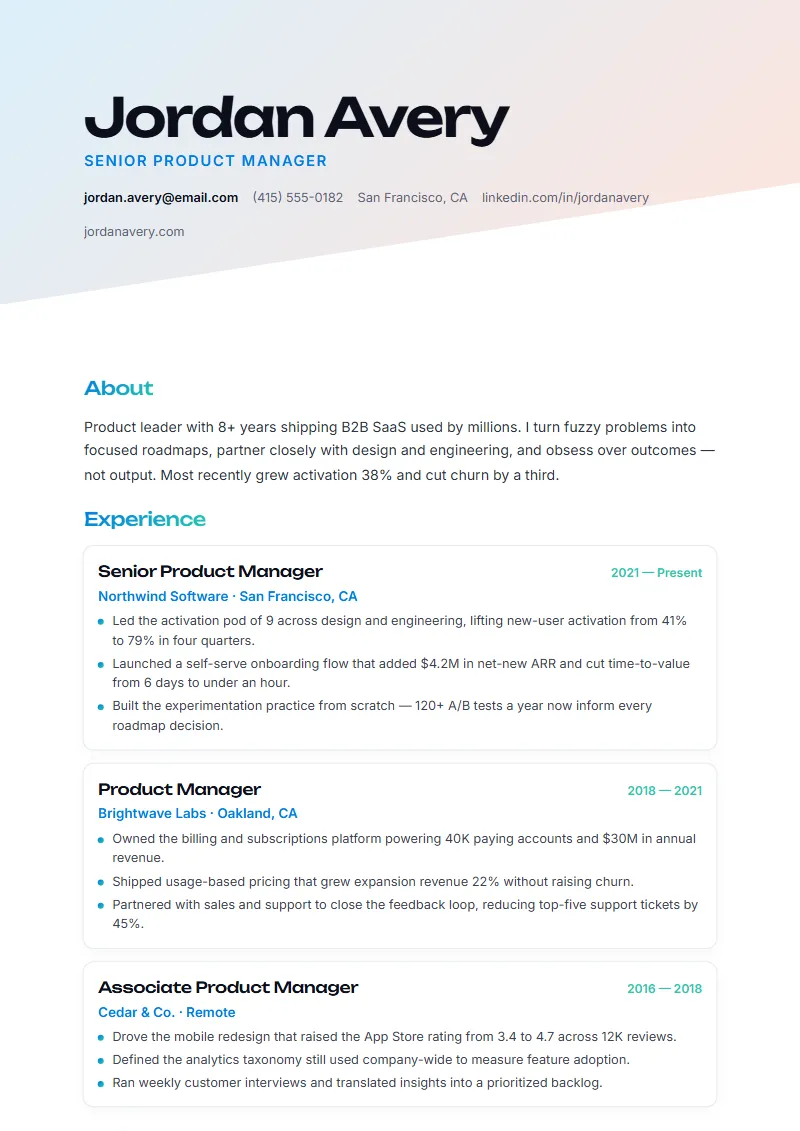
A Prism Rise layout filled with sample content. Every template on NavPeer is built to parse cleanly through applicant tracking systems — no text boxes, no sidebars that scramble your work history.
Interior Designer resume summary example
Three to four sentences at the top of the page, written in the first person without saying “I”. Rewrite it for every application — the summary is the cheapest place to show you read the job description.
8 interior designer resume bullet points you can adapt
Copy any of these and replace the specifics with your own. The numbers here are realistic examples, not claims to borrow — swap in what actually happened, because you will be asked about every figure on your resume.
- Delivered 30+ commercial interiors projects from 2,000 to 90,000 square feet, spanning workplace, hospitality, and mixed-use.
- Led the design of a 90,000 sq ft workplace fit-out on a $14M budget, from programming and test fits through construction administration.
- Specify and manage FF&E packages up to $2.4M including sourcing, sample coordination, procurement, and installation oversight.
- Produce construction documentation in Revit including plans, elevations, millwork details, and finish schedules to permit-ready standard.
- Ensure ADA, egress, and building code compliance across all documented work, with no code-related plan check comments on the last 12 submittals.
- Cut a client's furniture budget 18% ($310K) without changing the design intent, by re-specifying three high-volume items to alternate manufacturers.
- Present design concepts to client stakeholder groups including executive leadership, with an average approval at second presentation.
- Coordinate with architects, MEP engineers, and contractors through construction, resolving 40+ field conditions without design compromise.
ATS keywords for this role
Applicant tracking systems match literal strings. Work the ones that genuinely apply to you into your summary, skills section, and bullets — and never into white text or a hidden block, which every modern system detects and most employers treat as disqualifying.
Section-by-section breakdown
Name the sector and project scale
Residential, workplace, hospitality, or healthcare, with square footage and budget. Firms staff by sector and scale, and portfolios alone rarely make this legible fast enough.
State your documentation depth
Whether you produce permit-ready construction documents is one of the biggest differentiators between designers, and it directly determines what a firm can bill you for.
Claim NCIDQ if you have it
It is the profession's recognised certification, required for registration in many states, and a clear differentiator on commercial projects.
What your portfolio needs to do
In this field the portfolio is the hiring instrument and the resume is the supporting document. Put the link in your header — not the footer, not a section at the bottom — and make sure it loads fast on a phone.
- Curate per application. Six to ten pieces chosen for this employer beats a complete archive every time.
- Give every piece context: the brief, the constraint, and what happened afterwards.
- Check every link before you send. Dead portfolio links are read as carelessness about your own work.
- If the work is under NDA, say so and include the password rather than making the reviewer ask.
Core skills for this role
A human reviewer scans this section to decide whether to read the rest. Keep it to the skills you would be comfortable being interviewed on in depth.
Mistakes that sink interior designer resumes
These are the failure modes specific to this role — not general resume advice you have already read a dozen times.
- Portfolio images with no project data — square footage, budget, and your role.
- Not distinguishing residential from commercial work, which are genuinely different practices.
- Omitting code and ADA knowledge on commercial applications.
- Leaving out FF&E procurement, which is a large part of the commercial job.
- Listing rendering skill without documentation skill, which reads as a visualiser rather than a designer.
Frequently asked questions
Related resume examples
Build your interior designer resume
Start from an ATS-safe template and write your real experience into it. Nothing here invents an employer, a title, or a number — the live ATS score just tells you what the job is looking for.