Graphic Designer Resume Example & Guide
A real example, 8 bullet points you can copy, salary ranges, and the specific things that get graphic designer resumes rejected.
Graphic design hiring is portfolio-first, which frees the resume to do the thing portfolios cannot: prove that your design work produced results and that you can operate at volume inside a brand system. Anyone can produce one beautiful piece; producing 40 on-brand assets a month across six channels is the job.
Business outcomes are the differentiator. Conversion lifts from redesigned assets, packaging that moved shelf performance, and rebrands that shipped across every touchpoint are what turn a portfolio review into an offer.
What hiring managers look for in a graphic designer resume
- A curated portfolio matched to their work, not a complete archive
- Production volume and turnaround capability
- Brand system thinking, not just individual pieces
- Results where measurable — conversion, engagement, sales
- Print and production knowledge where relevant
Graphic Designer salary range
Approximate US ranges for guidance when you are setting expectations or preparing to negotiate. Actual pay varies considerably by city, employer size, and industry.
Entry
$45K – $60K
0–2 years
Mid
$60K – $82K
3–7 years
Senior
$82K – $115K
8+ years
Graphic Designer resume example
A Palette layout filled with sample content. Every template on NavPeer is built to parse cleanly through applicant tracking systems — no text boxes, no sidebars that scramble your work history.
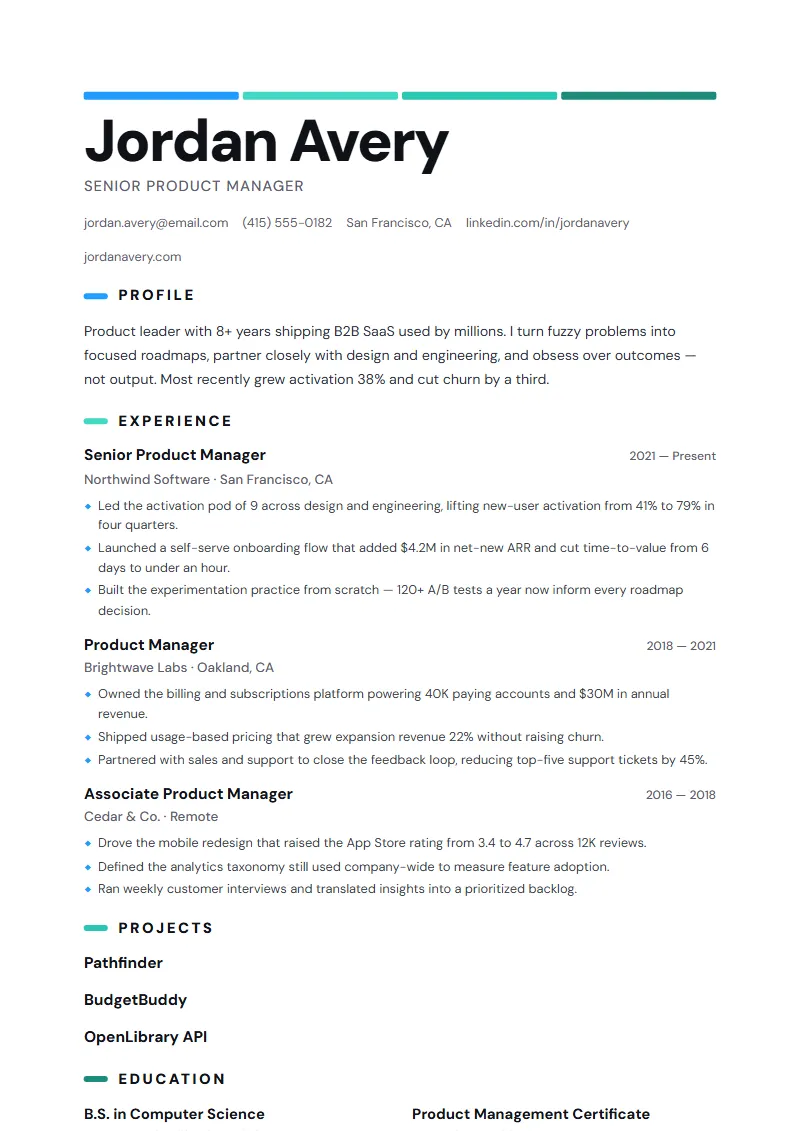
Graphic Designer resume summary example
Three to four sentences at the top of the page, written in the first person without saying “I”. Rewrite it for every application — the summary is the cheapest place to show you read the job description.
8 graphic designer resume bullet points you can adapt
Copy any of these and replace the specifics with your own. The numbers here are realistic examples, not claims to borrow — swap in what actually happened, because you will be asked about every figure on your resume.
- Produce 40+ on-brand assets monthly across paid social, email, web, print collateral, and packaging, with a standard 48-hour turnaround on campaign requests.
- Led the visual rollout of a full rebrand across 200+ touchpoints — packaging, retail signage, digital, and collateral — completed in 5 months with no schedule slip.
- Redesigned packaging for the core product line; retail sell-through rose 14% in the two quarters following the shelf reset.
- Built the brand asset library and template system in Figma, letting marketing self-serve 60% of routine requests and cutting design queue time roughly in half.
- Designed paid social creative tested against control; winning variants cut cost per acquisition 26% across the primary channel.
- Manage print production end to end including press checks, colour proofing, and vendor coordination across 3 printers, with no reprints for colour error in 4 years.
- Created the illustration system now used across the product education materials, replacing purchased stock and giving the brand a distinct visual signature.
- Art-directed 6 photo shoots including shot lists, styling direction, and retouching supervision.
ATS keywords for this role
Applicant tracking systems match literal strings. Work the ones that genuinely apply to you into your summary, skills section, and bullets — and never into white text or a hidden block, which every modern system detects and most employers treat as disqualifying.
Section-by-section breakdown
Curate the portfolio per application
Send packaging work to packaging roles and digital work to digital roles. A single archive portfolio undersells you everywhere; six to ten pieces chosen for the specific employer converts far better.
State production volume
Assets per month and typical turnaround. In-house design hiring is largely about whether you can sustain throughput inside a brand system, and portfolios never show this.
Attach results where you can
Conversion lifts, sell-through, engagement. Design that moved a number is the rarest thing on a design resume and the most persuasive.
What your portfolio needs to do
In this field the portfolio is the hiring instrument and the resume is the supporting document. Put the link in your header — not the footer, not a section at the bottom — and make sure it loads fast on a phone.
- Curate per application. Six to ten pieces chosen for this employer beats a complete archive every time.
- Give every piece context: the brief, the constraint, and what happened afterwards.
- Check every link before you send. Dead portfolio links are read as carelessness about your own work.
- If the work is under NDA, say so and include the password rather than making the reviewer ask.
Core skills for this role
A human reviewer scans this section to decide whether to read the rest. Keep it to the skills you would be comfortable being interviewed on in depth.
Mistakes that sink graphic designer resumes
These are the failure modes specific to this role — not general resume advice you have already read a dozen times.
- A portfolio link that is slow, broken, or requires a download.
- Listing Adobe applications as skills — they are assumed, and the space is better spent elsewhere.
- Showing only student or concept work when you have professional output.
- No production or brand-system evidence, which is what in-house roles are actually buying.
- An over-designed resume PDF that parses badly through ATS. Put the design in the portfolio.
Frequently asked questions
Related resume examples
Build your graphic designer resume
Start from an ATS-safe template and write your real experience into it. Nothing here invents an employer, a title, or a number — the live ATS score just tells you what the job is looking for.