UI Designer Resume Example & Guide
A real example, 8 bullet points you can copy, salary ranges, and the specific things that get ui designer resumes rejected.
UI design resumes compete on craft, which the resume itself cannot show — so the resume's job is to establish that your craft operates at scale and under constraint. Anyone can make one beautiful screen. Keeping 200 screens visually coherent across three teams and two platforms is the job being hired for.
Systems thinking is the differentiator. Type scales, spacing systems, colour tokens, and component libraries are what turn visual talent into something an engineering organisation can build on, and they translate directly into resume bullets with numbers attached.
Do not neglect accessibility. Contrast ratios, focus states, and touch target sizing are UI decisions, and demonstrating that you make them deliberately separates a professional from a stylist.
What hiring managers look for in a ui designer resume
- A portfolio demonstrating range and consistency, not one hero project
- Design-system work: components, tokens, documentation, adoption
- Accessibility literacy — contrast, focus states, target sizes
- Collaboration with engineers, including handoff quality
- Brand and visual consistency across surfaces
UI Designer salary range
Approximate US ranges for guidance when you are setting expectations or preparing to negotiate. Actual pay varies considerably by city, employer size, and industry.
Entry
$62K – $88K
0–2 years
Mid
$88K – $120K
3–7 years
Senior
$120K – $160K
8+ years
UI Designer resume example
A Palette layout filled with sample content. Every template on NavPeer is built to parse cleanly through applicant tracking systems — no text boxes, no sidebars that scramble your work history.
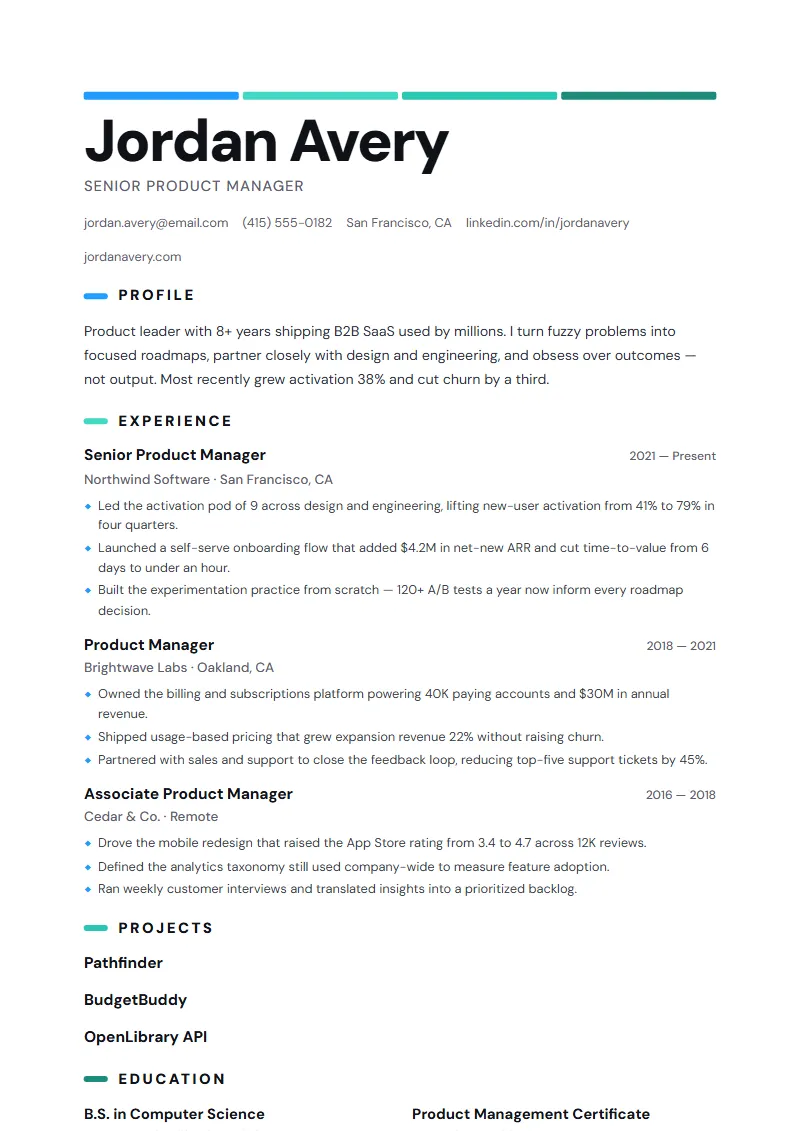
UI Designer resume summary example
Three to four sentences at the top of the page, written in the first person without saying “I”. Rewrite it for every application — the summary is the cheapest place to show you read the job description.
8 ui designer resume bullet points you can adapt
Copy any of these and replace the specifics with your own. The numbers here are realistic examples, not claims to borrow — swap in what actually happened, because you will be asked about every figure on your resume.
- Built and maintain a 120-component Figma library with tokenised colour, type, and spacing, adopted by 4 squads and cutting new-screen design time roughly 65%.
- Redesigned the product's visual language across 200+ screens over 4 months, delivered incrementally with no pause in the engineering roadmap.
- Raised all interface colour pairings to WCAG AA contrast, resolving 38 violations and rewriting the focus-state treatment for keyboard users.
- Defined a modular type scale and 8pt spacing system, ending a recurring source of design-QA tickets and cutting them 40%.
- Designed the mobile app interface for a 1.4M-download product, holding visual parity with web while respecting platform conventions on both.
- Created the icon set — 180 icons, single stroke system — replacing a mixed library of purchased assets and reducing bundle weight 22%.
- Partnered with engineering on a token pipeline that syncs Figma variables to code, eliminating hand-copied hex values as a bug source.
- Produced the design documentation and usage guidelines that let two new designers ship on-system work in their first week.
ATS keywords for this role
Applicant tracking systems match literal strings. Work the ones that genuinely apply to you into your summary, skills section, and bullets — and never into white text or a hidden block, which every modern system detects and most employers treat as disqualifying.
Section-by-section breakdown
Show the system, not just the screens
Include one portfolio piece that documents a design system — components, tokens, rules, adoption. It is the single most persuasive artefact for a UI hire at any company past ten people.
Quantify consistency work
Component counts, teams adopting, screens unified, QA tickets removed. Visual consistency work is otherwise invisible on a resume even though it is most of the senior job.
Keep the resume itself restrained
A heavily designed resume PDF parses badly through ATS and reviewers judge the portfolio, not the CV, for craft. Clean and readable is the correct choice here.
What your portfolio needs to do
In this field the portfolio is the hiring instrument and the resume is the supporting document. Put the link in your header — not the footer, not a section at the bottom — and make sure it loads fast on a phone.
- Curate per application. Six to ten pieces chosen for this employer beats a complete archive every time.
- Give every piece context: the brief, the constraint, and what happened afterwards.
- Check every link before you send. Dead portfolio links are read as carelessness about your own work.
- If the work is under NDA, say so and include the password rather than making the reviewer ask.
Core skills for this role
A human reviewer scans this section to decide whether to read the rest. Keep it to the skills you would be comfortable being interviewed on in depth.
Mistakes that sink ui designer resumes
These are the failure modes specific to this role — not general resume advice you have already read a dozen times.
- Portfolio pieces with no context. A screenshot without the problem, constraints, or outcome is decoration.
- Only showing greenfield concept work. Employers want evidence you can work inside an existing system you did not create.
- Skipping accessibility, which is now a standard screening question for interface roles.
- Confusing UI and UX framing. If you do both, say so explicitly; if you do one, target the postings for it.
- Listing Adobe tools prominently for product work when the industry standard is Figma.
Frequently asked questions
Related resume examples
Build your ui designer resume
Start from an ATS-safe template and write your real experience into it. Nothing here invents an employer, a title, or a number — the live ATS score just tells you what the job is looking for.