UX Designer Resume Example & Guide
A real example, 9 bullet points you can copy, salary ranges, and the specific things that get ux designer resumes rejected.
UX hiring runs on the portfolio, and the resume's job is to get the portfolio opened. That means the resume must do something the portfolio cannot: prove that your design work changed a number. Case studies show process; the resume shows consequence.
The most common weakness in UX resumes is describing artefacts. Wireframes produced, prototypes built, and personas created are inputs. Task success rate, error rate, support ticket volume, conversion, and retention are outputs — and they are what makes a design hire defensible to a product leader.
Research deserves explicit treatment. Designers who run their own studies, recruit their own participants, and can describe a finding that killed a planned feature are meaningfully more hireable than designers who only receive requirements.
What hiring managers look for in a ux designer resume
- A portfolio link that works, with 2–4 deep case studies rather than a gallery
- Business or usability metrics attached to shipped designs
- Research practice — methods, participant counts, what changed as a result
- Design-system contribution and cross-team collaboration
- Fluency working with engineers, including handoff and feasibility tradeoffs
UX Designer salary range
Approximate US ranges for guidance when you are setting expectations or preparing to negotiate. Actual pay varies considerably by city, employer size, and industry.
Entry
$70K – $98K
0–2 years
Mid
$98K – $135K
3–7 years
Senior
$135K – $180K
8+ years
UX Designer resume example
A Prism Rise layout filled with sample content. Every template on NavPeer is built to parse cleanly through applicant tracking systems — no text boxes, no sidebars that scramble your work history.
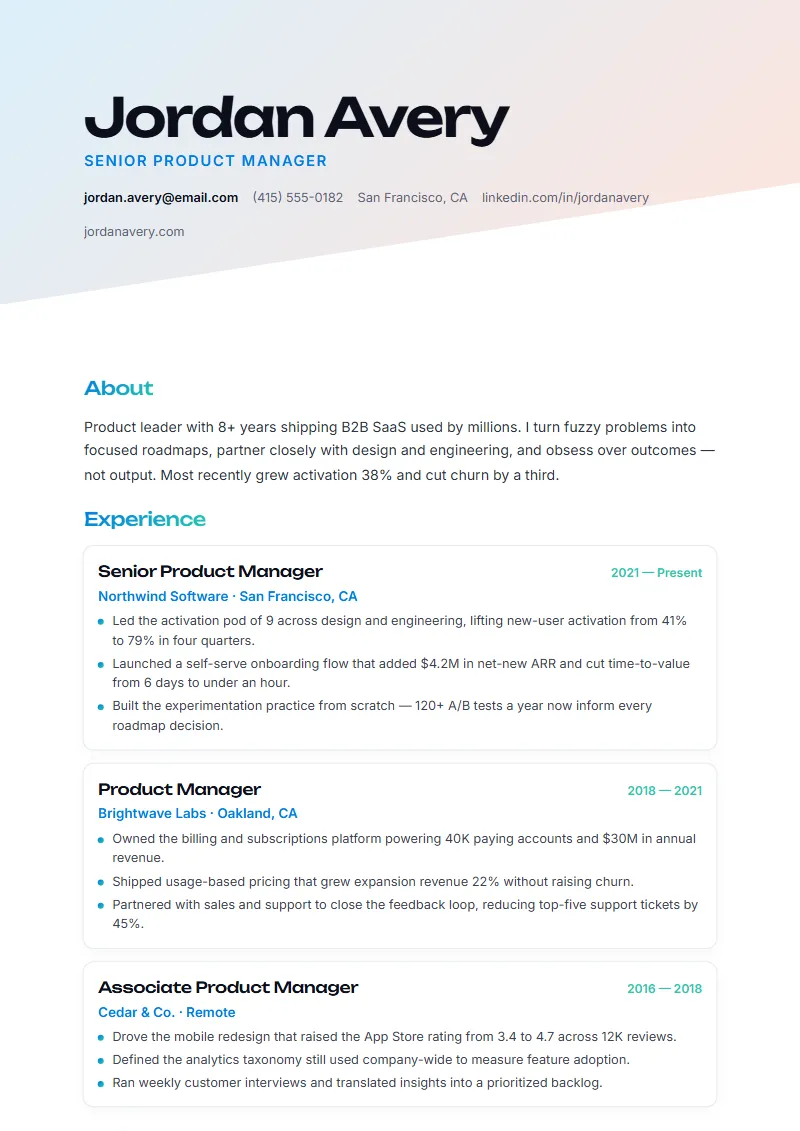
UX Designer resume summary example
Three to four sentences at the top of the page, written in the first person without saying “I”. Rewrite it for every application — the summary is the cheapest place to show you read the job description.
9 ux designer resume bullet points you can adapt
Copy any of these and replace the specifics with your own. The numbers here are realistic examples, not claims to borrow — swap in what actually happened, because you will be asked about every figure on your resume.
- Redesigned onboarding after 18 moderated sessions revealed users abandoning at permissions setup; activation rose from 34% to 61% over two releases.
- Cut task completion time on the core reporting workflow from 4.2 minutes to 1.6 by restructuring information architecture around user mental models rather than the database schema.
- Ran 40+ moderated usability sessions across 3 product areas, producing findings that killed two planned features before engineering time was committed.
- Built and maintain the design system in Figma — 90 components, tokenised — adopted by 3 squads and cutting design-to-development handoff questions roughly 60%.
- Redesigned the error and empty states across the product, reducing support tickets in the affected flows 44%.
- Led accessibility remediation to WCAG 2.1 AA, resolving 74 issues and rewriting the navigation for full keyboard traversal.
- Partnered with data to instrument the funnel, replacing an internal argument about where users dropped off with a measured answer.
- Facilitated 6 cross-functional design sprints, each ending in a tested prototype and a go/no-go decision inside a week.
- Reduced the checkout flow from 7 steps to 3 after journey mapping, lifting completion 19%.
ATS keywords for this role
Applicant tracking systems match literal strings. Work the ones that genuinely apply to you into your summary, skills section, and bullets — and never into white text or a hidden block, which every modern system detects and most employers treat as disqualifying.
Section-by-section breakdown
Portfolio URL in the header, with a password if needed
Put the link and any access password directly in the header. A portfolio a reviewer cannot open in five seconds is functionally absent, and NDA-protected work needs the password stated rather than requested.
End every bullet in a consequence
Not 'designed a new dashboard' but 'designed a dashboard that cut time-to-first-insight from 6 minutes to 90 seconds'. Artefacts belong in the portfolio; outcomes belong on the resume.
Make research visible
Method, participant count, and the decision it drove. Designers who conduct research rather than consume it occupy a distinctly stronger position in hiring.
What your portfolio needs to do
In this field the portfolio is the hiring instrument and the resume is the supporting document. Put the link in your header — not the footer, not a section at the bottom — and make sure it loads fast on a phone.
- Curate per application. Six to ten pieces chosen for this employer beats a complete archive every time.
- Give every piece context: the brief, the constraint, and what happened afterwards.
- Check every link before you send. Dead portfolio links are read as carelessness about your own work.
- If the work is under NDA, say so and include the password rather than making the reviewer ask.
Core skills for this role
A human reviewer scans this section to decide whether to read the rest. Keep it to the skills you would be comfortable being interviewed on in depth.
Mistakes that sink ux designer resumes
These are the failure modes specific to this role — not general resume advice you have already read a dozen times.
- A portfolio that is a gallery of screenshots. Reviewers want two or three deep case studies with problem, process, and result.
- Listing tools prominently. Figma proficiency is assumed; it is not a differentiator and should not occupy prime space.
- No metrics anywhere, which leaves a product leader unable to justify the hire internally.
- Describing solo work when the reality was collaborative. Design leaders probe this specifically and inflated ownership is easy to detect.
- A visually elaborate resume PDF. It parses badly through the same ATS everyone else uses, and the portfolio is where design skill belongs.
Frequently asked questions
Related resume examples
Build your ux designer resume
Start from an ATS-safe template and write your real experience into it. Nothing here invents an employer, a title, or a number — the live ATS score just tells you what the job is looking for.