Pharmacist Resume Example & Guide
A real example, 9 bullet points you can copy, salary ranges, and the specific things that get pharmacist resumes rejected.
Pharmacy hiring splits sharply between retail, hospital, and clinical practice, and the resumes look genuinely different. Retail is judged on volume, accuracy, immunisation numbers, and customer throughput; hospital and clinical on interventions, protocols, rounding, and antimicrobial stewardship.
Whichever setting, the strongest currency is the intervention: a documented catch that prevented harm. Pharmacists routinely prevent interactions, dosing errors, and contraindicated prescriptions, and rarely count them. Interventions per month, with the categories, is a genuinely differentiating number.
License and residency status are the eligibility layer. State license number, PGY1/PGY2 completion, and board certification (BCPS, BCACP, BCOP) determine which roles are open to you at all.
What hiring managers look for in a pharmacist resume
- State pharmacist license with number, plus immunisation certification
- Setting-appropriate volume: scripts per day, or interventions per month
- Residency training and board certification for clinical roles
- Accuracy and safety record
- Protocol, stewardship, or MTM programme involvement
Certifications and licences for pharmacist roles
List these near the top of your resume. In this field they are eligibility requirements, not accomplishments — a recruiter cannot advance you without them.
- Pharmacist License (state, number, expiration)
- BCPS / BCACP / BCOP board certification
- Immunisation Certification (APhA)
- PGY1 / PGY2 Residency
- BLS / ACLS
Pharmacist salary range
Approximate US ranges for guidance when you are setting expectations or preparing to negotiate. Actual pay varies considerably by city, employer size, and industry.
Entry
$110K – $128K
0–2 years
Mid
$128K – $148K
3–7 years
Senior
$148K – $175K
8+ years
Pharmacist resume example
A Harbor layout filled with sample content. Every template on NavPeer is built to parse cleanly through applicant tracking systems — no text boxes, no sidebars that scramble your work history.
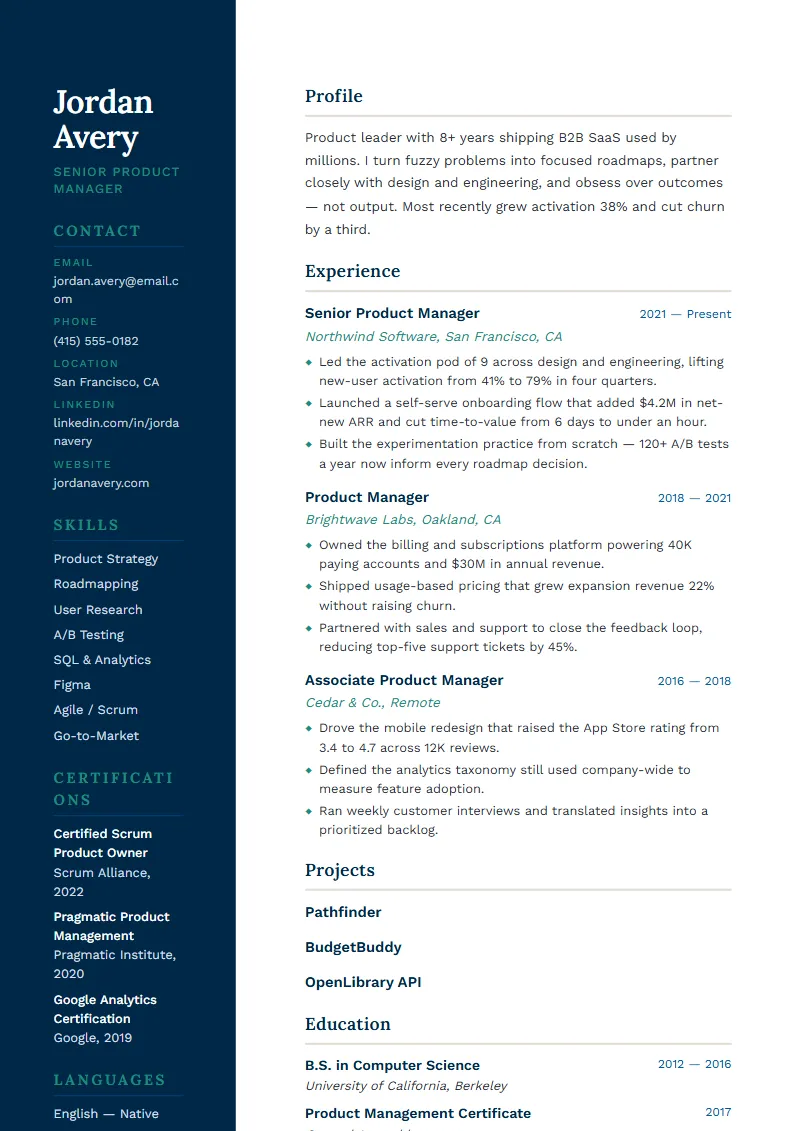
Pharmacist resume summary example
Three to four sentences at the top of the page, written in the first person without saying “I”. Rewrite it for every application — the summary is the cheapest place to show you read the job description.
9 pharmacist resume bullet points you can adapt
Copy any of these and replace the specifics with your own. The numbers here are realistic examples, not claims to borrow — swap in what actually happened, because you will be asked about every figure on your resume.
- Document 120+ clinical interventions monthly across internal medicine and ICU, including dose adjustments, interaction resolution, and therapeutic substitutions.
- Manage the pharmacokinetic dosing service for vancomycin and aminoglycosides across 180 patients a year, achieving target trough attainment in 91% of cases.
- Co-chair antimicrobial stewardship, driving a 23% reduction in broad-spectrum days of therapy over two years with no increase in mortality or readmission.
- Round daily with the internal medicine team, providing real-time pharmacotherapy recommendations with a 87% acceptance rate.
- Built the anticoagulation management protocol now used hospital-wide, cutting supratherapeutic INR events 38%.
- Verify 350+ orders per shift in Epic Willow with documented accuracy above 99.9% across 6 years.
- Administered 1,100+ immunisations annually including influenza, COVID-19, pneumococcal, and shingles, with full documentation to the state registry.
- Precept 6 PharmD students per year on APPE rotations and served as residency programme coordinator for two cycles.
- Led the formulary review that converted 14 high-cost agents to therapeutic equivalents, saving roughly $340K annually.
ATS keywords for this role
Applicant tracking systems match literal strings. Work the ones that genuinely apply to you into your summary, skills section, and bullets — and never into white text or a hidden block, which every modern system detects and most employers treat as disqualifying.
Section-by-section breakdown
Match the resume to the setting
A retail resume leads with volume, immunisations, and workflow; a clinical resume leads with interventions, protocols, and rounding. Sending one to the other type of employer reads as a poor fit even when you are qualified for both.
Count your interventions
Interventions per month with categories is the clearest evidence of clinical value a pharmacist can put on paper, and it is very rarely present.
Foreground residency and board certification
PGY1, PGY2, and BCPS/BCACP determine eligibility for most clinical roles. Put them in the summary line rather than in an education section at the bottom.
Core skills for this role
A human reviewer scans this section to decide whether to read the rest. Keep it to the skills you would be comfortable being interviewed on in depth.
Mistakes that sink pharmacist resumes
These are the failure modes specific to this role — not general resume advice you have already read a dozen times.
- Describing dispensing duties generically. 'Filled prescriptions accurately' is the baseline expectation, not an achievement.
- Omitting immunisation certification and volumes, which matter in nearly every retail and community role.
- No intervention data on a clinical resume, which is the field's core evidence.
- Ignoring the business side in retail — script volume, wait times, staffing, inventory shrink are all managed by the pharmacist.
- Leaving license number and state off, in a profession where verification is routine.
Frequently asked questions
Related resume examples
Build your pharmacist resume
Start from an ATS-safe template and write your real experience into it. Nothing here invents an employer, a title, or a number — the live ATS score just tells you what the job is looking for.