Registered Nurse Resume Example & Guide
A real example, 9 bullet points you can copy, salary ranges, and the specific things that get registered nurse resumes rejected.
Nursing resumes are screened differently from almost every other profession: the first pass is a compliance check, not an assessment of talent. License type, license state, expiration, and required certifications are verified before your experience is read at all. A brilliant RN resume that buries the license number on page two gets filtered by systems that never look for it.
Once you clear that gate, the differentiators are unit type, patient ratio, and acuity. "Med-surg, 1:6 ratio" and "ICU, 1:2 ratio with vents and CRRT" describe very different clinicians, and nurse managers read those numbers first. Include them for every position.
The other underused lever is quality metrics. Falls, CLABSI and CAUTI rates, HCAHPS scores, and readmission numbers are tracked on every unit in the country, and a nurse who can attach them to their own practice or a committee they served on stands out immediately from a field of duty-list resumes.
What hiring managers look for in a registered nurse resume
- Active RN license with state, number, and expiration — plus compact status if applicable
- Current BLS/ACLS/PALS and any unit-specific certification
- Unit type, bed count, patient ratio, and acuity for each role
- EMR system by name — Epic and Cerner are hard filters in many systems
- Quality and safety outcomes, or committee and preceptor involvement
Certifications and licences for registered nurse roles
List these near the top of your resume. In this field they are eligibility requirements, not accomplishments — a recruiter cannot advance you without them.
- RN License (state, number, expiration)
- BLS — Basic Life Support
- ACLS — Advanced Cardiovascular Life Support
- PALS — Pediatric Advanced Life Support
- PCCN / CMSRN (specialty certification)
Registered Nurse salary range
Approximate US ranges for guidance when you are setting expectations or preparing to negotiate. Actual pay varies considerably by city, employer size, and industry.
Entry
$62K – $80K
0–2 years
Mid
$80K – $102K
3–7 years
Senior
$102K – $135K
8+ years
Registered Nurse resume example
A Anchor layout filled with sample content. Every template on NavPeer is built to parse cleanly through applicant tracking systems — no text boxes, no sidebars that scramble your work history.
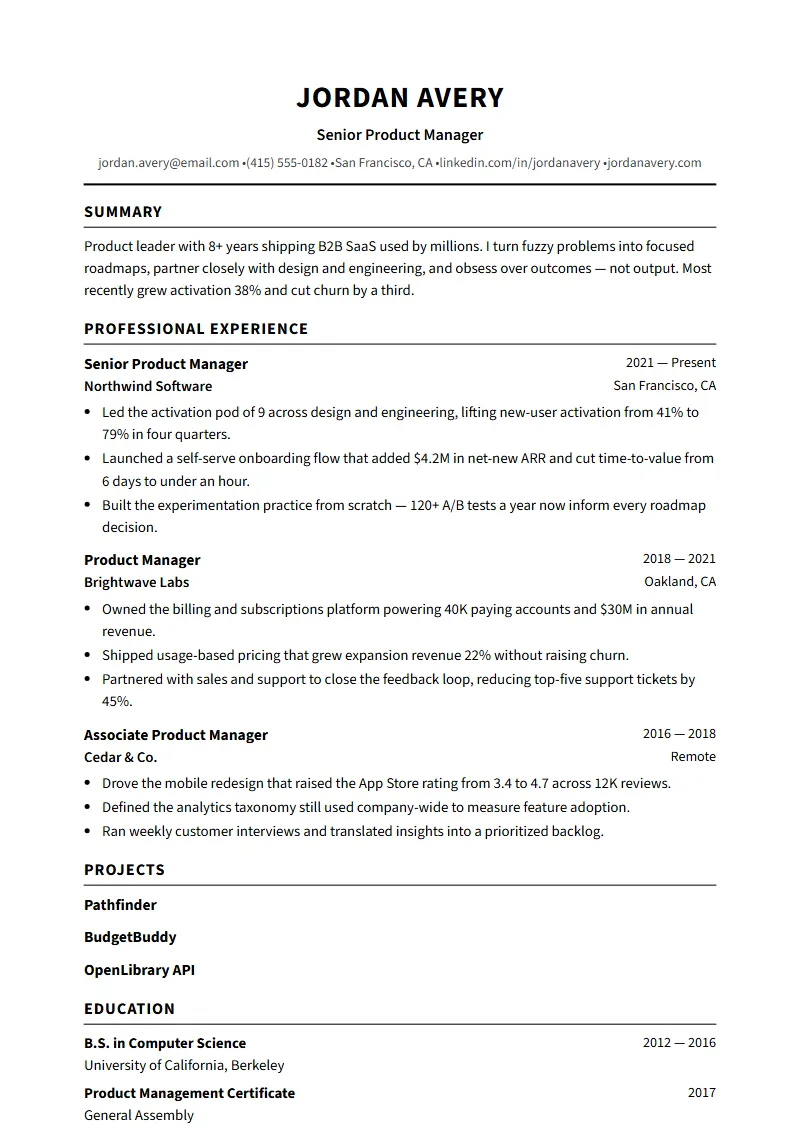
Registered Nurse resume summary example
Three to four sentences at the top of the page, written in the first person without saying “I”. Rewrite it for every application — the summary is the cheapest place to show you read the job description.
9 registered nurse resume bullet points you can adapt
Copy any of these and replace the specifics with your own. The numbers here are realistic examples, not claims to borrow — swap in what actually happened, because you will be asked about every figure on your resume.
- Provide direct care for 5–6 patients per shift on a 32-bed med-surg/telemetry unit, including post-operative recovery, cardiac monitoring, and complex wound management.
- Served as charge nurse for 2 shifts weekly, coordinating assignments for 8 nurses and 4 techs, managing admissions and discharges, and escalating rapid responses.
- Led the unit falls-prevention initiative, implementing hourly rounding and a bedside risk handoff; falls with injury fell 41% over 12 months.
- Precepted 11 new graduate nurses through orientation; 10 remained on the unit past their first year against a hospital average of 68% retention.
- Reduced CAUTI rate on the unit from 2.1 to 0.4 per 1,000 catheter days by championing daily necessity review and standardising insertion documentation.
- Managed care for patients on continuous cardiac monitoring, identifying and escalating 14 significant arrhythmias for immediate intervention.
- Improved unit HCAHPS communication scores from the 62nd to the 84th percentile by introducing structured bedside shift report with family present.
- Administered medications and blood products with zero documented administration errors across 6 years and roughly 1,100 shifts.
- Served on the shared-governance practice council, rewriting the discharge teaching protocol now used across three units.
ATS keywords for this role
Applicant tracking systems match literal strings. Work the ones that genuinely apply to you into your summary, skills section, and bullets — and never into white text or a hidden block, which every modern system detects and most employers treat as disqualifying.
Section-by-section breakdown
Put licensure in the top third, in full
License type, number, issuing state, and expiration date, plus multistate compact status if you hold it. Many healthcare ATS configurations parse for these fields specifically, and recruiters will not chase a resume that omits them.
Give every position its unit profile
Unit type, bed count, patient ratio, and acuity. A nurse manager reads these to know instantly whether you can handle their floor — no other detail on a nursing resume does as much work in as little space.
Name the EMR
Epic, Cerner, Meditech. Systems train to their EMR and a matching candidate is cheaper to onboard, so it is a genuine screening factor and a common ATS keyword.
Counting your clinical hours
Supervised clinical hours are real, documented patient care and belong on the resume as experience entries — facility, unit, hours, patient population, and the skills you performed. Formatting them as a footnote under Education is the most common way strong candidates in this field undersell themselves.
Be precise about what you performed independently versus observed or assisted with. Preceptors and clinical supervisors find out in the first week, and overstating here damages your standing far more than a shorter list would have.
Core skills for this role
A human reviewer scans this section to decide whether to read the rest. Keep it to the skills you would be comfortable being interviewed on in depth.
Mistakes that sink registered nurse resumes
These are the failure modes specific to this role — not general resume advice you have already read a dozen times.
- Listing generic duties. 'Administered medications and monitored patients' describes every RN in the country and distinguishes you from none of them.
- Omitting the patient ratio, which is the fastest available signal of the intensity you are used to working at.
- Burying certifications at the bottom. BLS and ACLS are eligibility requirements, not accomplishments, and they need to be visible immediately.
- Ignoring quality metrics that your unit already tracks — falls, infection rates, HCAHPS, readmissions.
- Using a two-column template. Large hospital systems run some of the strictest ATS parsers in any industry, and sidebars frequently scramble.
Frequently asked questions
Related resume examples
Build your registered nurse resume
Start from an ATS-safe template and write your real experience into it. Nothing here invents an employer, a title, or a number — the live ATS score just tells you what the job is looking for.