Medical Assistant Resume Example & Guide
A real example, 9 bullet points you can copy, salary ranges, and the specific things that get medical assistant resumes rejected.
Medical assisting is a hybrid role, and the resumes that get interviews make the split explicit. Clinical duties — vitals, injections, phlebotomy, EKG, specimen handling — and administrative duties — scheduling, insurance verification, prior authorisations, EMR management — are hired for in different proportions by different practices.
Certification is the main filter. CMA (AAMA), RMA (AMT), and CCMA (NHA) are distinct credentials and many postings name one specifically. Write yours exactly, with the granting body, because practices verify it.
Volume is your quantification lever. Patients roomed per day, providers supported, and specimens drawn per week tell a practice manager whether you can keep pace with their clinic, and almost no medical assistant resume includes them.
What hiring managers look for in a medical assistant resume
- Certification with the granting body, plus current BLS
- Clinical competencies named specifically, especially phlebotomy and injections
- EMR system by name
- Volume: patients per day, providers supported
- Insurance, authorisation, and scheduling experience for administrative-heavy roles
Certifications and licences for medical assistant roles
List these near the top of your resume. In this field they are eligibility requirements, not accomplishments — a recruiter cannot advance you without them.
- CMA (AAMA) / RMA (AMT) / CCMA (NHA)
- BLS — Basic Life Support
- Phlebotomy certification
- EKG technician certification
Medical Assistant salary range
Approximate US ranges for guidance when you are setting expectations or preparing to negotiate. Actual pay varies considerably by city, employer size, and industry.
Entry
$34K – $42K
0–2 years
Mid
$42K – $52K
3–7 years
Senior
$52K – $65K
8+ years
Medical Assistant resume example
A Plain Text layout filled with sample content. Every template on NavPeer is built to parse cleanly through applicant tracking systems — no text boxes, no sidebars that scramble your work history.
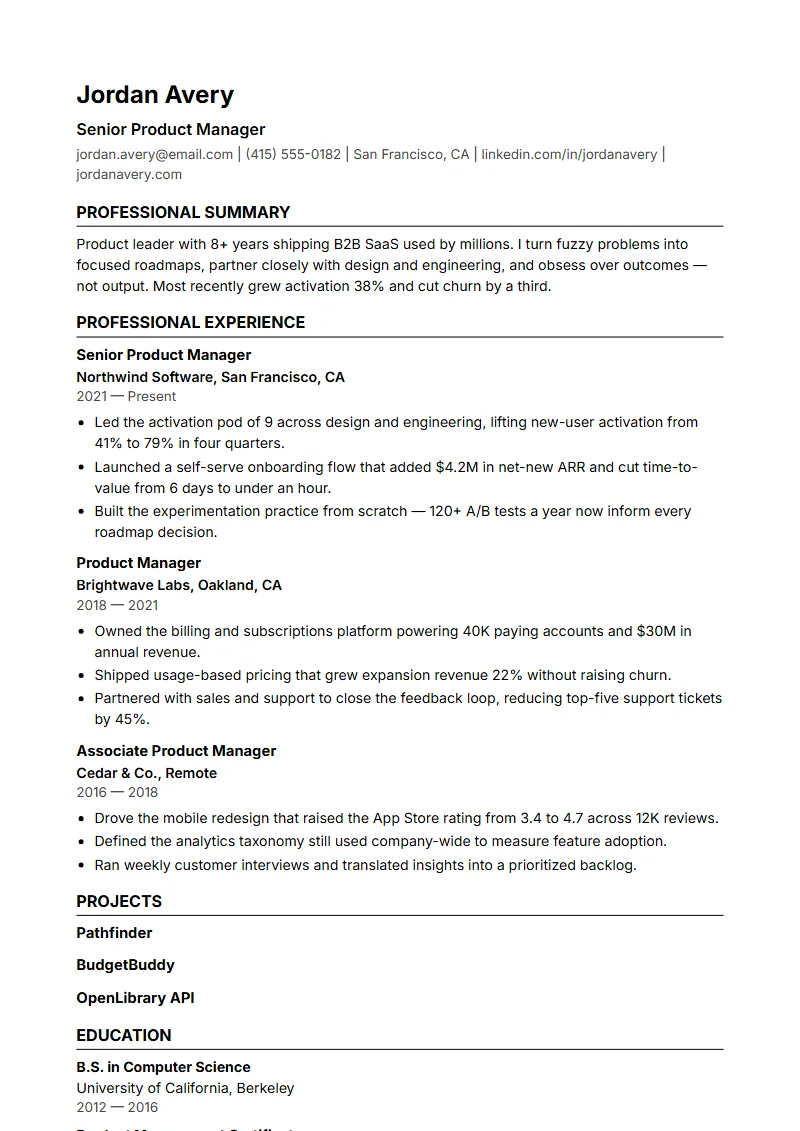
Medical Assistant resume summary example
Three to four sentences at the top of the page, written in the first person without saying “I”. Rewrite it for every application — the summary is the cheapest place to show you read the job description.
9 medical assistant resume bullet points you can adapt
Copy any of these and replace the specifics with your own. The numbers here are realistic examples, not claims to borrow — swap in what actually happened, because you will be asked about every figure on your resume.
- Room 35–40 patients daily across 6 providers — vitals, medication reconciliation, chief complaint documentation, and visit preparation in Epic.
- Perform 25+ venipunctures weekly with a first-stick success rate above 95%, including difficult draws on paediatric and elderly patients.
- Administer immunisations and therapeutic injections (IM, subcutaneous, intradermal) for roughly 60 patients a week with documented zero administration errors.
- Cut prior authorisation turnaround from 6 days to 2 by building a tracking log and calling payers directly rather than waiting on portal responses.
- Perform and prepare 12-lead EKGs for provider review, flagging abnormal findings for immediate attention.
- Manage the referral queue for 6 providers — roughly 90 referrals a month — tracking each to completed appointment rather than to send.
- Verify insurance eligibility and benefits for all scheduled patients, cutting day-of-service coverage surprises roughly 70%.
- Serve as Spanish interpreter for clinical visits, improving access for the roughly 30% of the panel who are Spanish-preferred.
- Trained 4 new medical assistants on clinic workflow and EMR documentation standards.
ATS keywords for this role
Applicant tracking systems match literal strings. Work the ones that genuinely apply to you into your summary, skills section, and bullets — and never into white text or a hidden block, which every modern system detects and most employers treat as disqualifying.
Section-by-section breakdown
Split clinical and administrative skills
Two clearly labelled groupings. Practices weight these very differently — a specialty clinic may want a mostly clinical MA while a busy primary care office needs the administrative half — and the split lets a manager see the match immediately.
Write the certification exactly
CMA (AAMA), RMA (AMT), or CCMA (NHA), with the certification number. These are distinct credentials, postings often name one, and employers verify them.
Quantify daily volume
Patients roomed, providers supported, draws performed. It is the clearest evidence that you can work at clinic pace, which is the practical question behind the interview.
Core skills for this role
A human reviewer scans this section to decide whether to read the rest. Keep it to the skills you would be comfortable being interviewed on in depth.
Mistakes that sink medical assistant resumes
These are the failure modes specific to this role — not general resume advice you have already read a dozen times.
- Listing duties with no volume. Every MA rooms patients; the number tells the reviewer at what pace.
- Omitting the EMR by name, which is a common filter and a real onboarding cost for the practice.
- Leaving off bilingual ability, which is one of the highest-value differentiators in outpatient hiring.
- Vague certification claims. 'Certified Medical Assistant' without the granting body reads as imprecise in a field that verifies credentials.
- Neglecting insurance and authorisation experience, which is often the specific pain the practice is hiring to relieve.
Frequently asked questions
Related resume examples
Build your medical assistant resume
Start from an ATS-safe template and write your real experience into it. Nothing here invents an employer, a title, or a number — the live ATS score just tells you what the job is looking for.