Phlebotomist Resume Example & Guide
A real example, 9 bullet points you can copy, salary ranges, and the specific things that get phlebotomist resumes rejected.
Phlebotomy resumes are read for three things: volume, first-stick success, and difficult-draw capability. A hospital lab drawing 400 patients a shift needs to know you can hold pace; a paediatric or oncology setting needs to know you can handle fragile veins and frightened patients.
Certification and setting range widen your options considerably. Inpatient, outpatient draw stations, mobile and home draws, plasma donation, and blood bank collection are different environments with different employer pools.
Specimen integrity is the quiet differentiator. Hemolysis rates, labelling accuracy, and chain-of-custody handling for drug screens are all measurable and all directly affect whether a lab has to recollect — which is the cost your employer feels.
What hiring managers look for in a phlebotomist resume
- Phlebotomy certification (ASCP, NHA, AMT) and current BLS
- Draws per shift and first-stick success rate
- Difficult population experience: paediatric, geriatric, oncology, dialysis
- Specimen handling accuracy — labelling, hemolysis, chain of custody
- EHR and lab information system familiarity
Certifications and licences for phlebotomist roles
List these near the top of your resume. In this field they are eligibility requirements, not accomplishments — a recruiter cannot advance you without them.
- PBT (ASCP) / CPT (NHA) / RPT (AMT)
- BLS — Basic Life Support
- Chain of Custody / DOT specimen collection
- State phlebotomy license (CA, LA, NV, WA)
Phlebotomist salary range
Approximate US ranges for guidance when you are setting expectations or preparing to negotiate. Actual pay varies considerably by city, employer size, and industry.
Entry
$32K – $38K
0–2 years
Mid
$38K – $46K
3–7 years
Senior
$46K – $58K
8+ years
Phlebotomist resume example
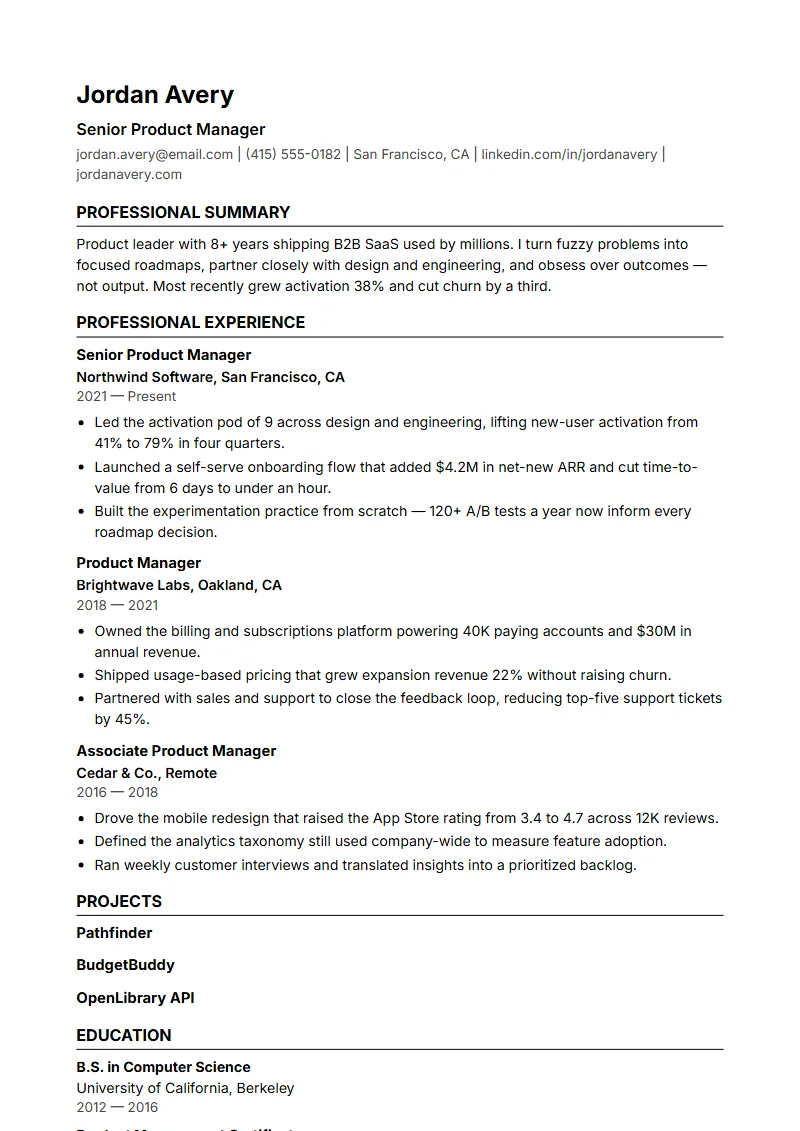
A Plain Text layout filled with sample content. Every template on NavPeer is built to parse cleanly through applicant tracking systems — no text boxes, no sidebars that scramble your work history.
Phlebotomist resume summary example
Three to four sentences at the top of the page, written in the first person without saying “I”. Rewrite it for every application — the summary is the cheapest place to show you read the job description.
9 phlebotomist resume bullet points you can adapt
Copy any of these and replace the specifics with your own. The numbers here are realistic examples, not claims to borrow — swap in what actually happened, because you will be asked about every figure on your resume.
- Perform 60–80 venipunctures per shift across inpatient floors, ICU, and the outpatient draw station, with a 97% first-stick success rate.
- Maintain a specimen hemolysis rate under 1.2% against a lab average of 3.1%, reducing recollections and the delays they cause to results.
- Handle escalated difficult draws for the department — paediatric, oncology with compromised veins, dialysis patients, and geriatric patients on anticoagulants.
- Collect and process chain-of-custody specimens for employment and DOT drug screening with zero documentation errors across 3 years.
- Achieved zero patient misidentification events across roughly 60,000 collections by strict two-identifier verification at the bedside before every draw.
- Process and centrifuge specimens for the lab, maintaining order-of-draw and temperature requirements for 40+ test types.
- Cut outpatient draw station wait times from 22 minutes to 9 by restructuring the queue and pre-labelling for scheduled draws.
- Trained 5 new phlebotomists on technique, order of draw, and de-escalation with anxious patients.
- Cover mobile draws at 3 long-term care facilities, managing routes, supplies, and specimen transport within stability windows.
ATS keywords for this role
Applicant tracking systems match literal strings. Work the ones that genuinely apply to you into your summary, skills section, and bullets — and never into white text or a hidden block, which every modern system detects and most employers treat as disqualifying.
Metrics worth pulling before you write
These are already measured about you. Ten minutes finding the real numbers will do more for this resume than an hour of rewording.
- Draws per shift
- First-stick success rate
- Specimen hemolysis rate
- Labelling accuracy
- Patient wait time
Section-by-section breakdown
Lead with volume and first-stick rate
Draws per shift and first-stick success. These are the two numbers a lab supervisor uses to judge a phlebotomist, and most resumes omit both.
Name your difficult populations
Paediatric, geriatric, oncology, dialysis, bariatric. Difficult-draw capability is the skill that makes you hard to replace and it should be explicit.
Include specimen quality metrics
Hemolysis rate and labelling accuracy directly affect lab rework and turnaround time. Quantifying them shows you understand the downstream cost of your work.
Core skills for this role
A human reviewer scans this section to decide whether to read the rest. Keep it to the skills you would be comfortable being interviewed on in depth.
Mistakes that sink phlebotomist resumes
These are the failure modes specific to this role — not general resume advice you have already read a dozen times.
- No volume figures, leaving a supervisor unable to assess pace.
- Omitting difficult-population experience, which is the main differentiator between phlebotomists.
- Skipping certification detail in a role where it is usually required.
- Ignoring the patient-experience side — phlebotomists are frequently the most anxiety-inducing contact in a visit and de-escalation skill is genuinely valued.
- Leaving off the lab information system, commonly a filter in hospital hiring.
Frequently asked questions
Related resume examples
Build your phlebotomist resume
Start from an ATS-safe template and write your real experience into it. Nothing here invents an employer, a title, or a number — the live ATS score just tells you what the job is looking for.