Photographer Resume Example & Guide
A real example, 8 bullet points you can copy, salary ranges, and the specific things that get photographer resumes rejected.
Photography hiring is portfolio-led, but commercial photography roles — as distinct from freelance client work — are hired on reliability and throughput as much as on eye. Shots delivered per day, consistency across a catalogue, and turnaround from shoot to delivered assets are what an e-commerce or content team is buying.
The resume should also establish which photography you do. Product, lifestyle, portrait, event, and architectural work require different lighting knowledge, different gear, and different studio setups, and employers hire for a specific one.
What hiring managers look for in a photographer resume
- Portfolio matching their category of work
- Volume: shots or SKUs per day, shoots per month
- Post-production capability and turnaround
- Lighting competence, studio and location
- Reliability on commercial deliverables and specs
Photographer salary range
Approximate US ranges for guidance when you are setting expectations or preparing to negotiate. Actual pay varies considerably by city, employer size, and industry.
Entry
$38K – $52K
0–2 years
Mid
$52K – $72K
3–7 years
Senior
$72K – $105K
8+ years
Photographer resume example
A Palette layout filled with sample content. Every template on NavPeer is built to parse cleanly through applicant tracking systems — no text boxes, no sidebars that scramble your work history.
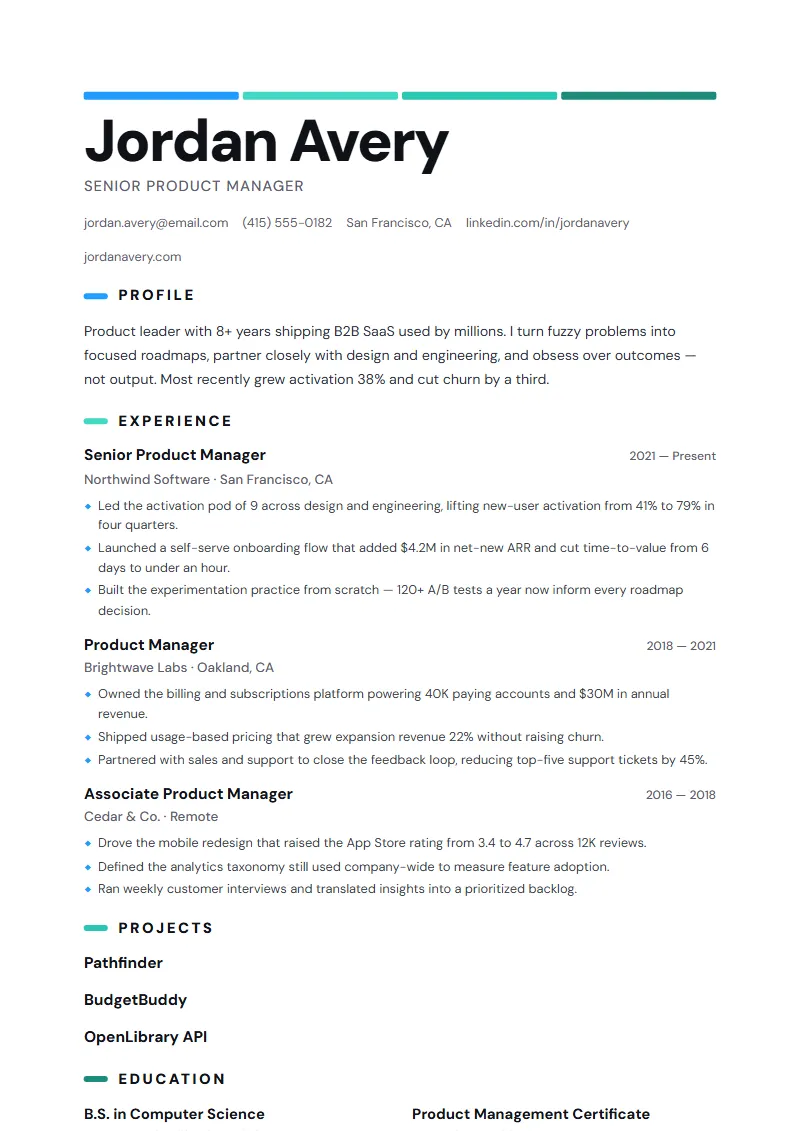
Photographer resume summary example
Three to four sentences at the top of the page, written in the first person without saying “I”. Rewrite it for every application — the summary is the cheapest place to show you read the job description.
8 photographer resume bullet points you can adapt
Copy any of these and replace the specifics with your own. The numbers here are realistic examples, not claims to borrow — swap in what actually happened, because you will be asked about every figure on your resume.
- Shoot 120+ product images daily tethered in Capture One, holding lighting and colour consistency across a 4,000-SKU catalogue.
- Deliver retouched, web-ready assets within 48 hours of shoot, cutting the previous outsourced turnaround from 3 weeks.
- Built and calibrated the in-house studio — lighting, backdrops, tethering, and colour-managed workflow — replacing an agency arrangement and saving roughly $140K annually.
- Shoot lifestyle and campaign imagery on location including talent direction, styling coordination, and natural-light problem solving.
- Established the shot list and naming convention for the product pipeline, cutting asset misfiling and re-shoots roughly 70%.
- Retouch to a defined brand standard with consistent colour, shadow, and crop specifications across every channel deliverable.
- Produced photography for 3 seasonal campaigns including pre-production planning, shoot execution, and final selects delivered to marketing on schedule.
- Manage the digital asset library of 60,000+ images with metadata tagging, so marketing can self-serve rather than requesting files.
ATS keywords for this role
Applicant tracking systems match literal strings. Work the ones that genuinely apply to you into your summary, skills section, and bullets — and never into white text or a hidden block, which every modern system detects and most employers treat as disqualifying.
Metrics worth pulling before you write
These are already measured about you. Ten minutes finding the real numbers will do more for this resume than an hour of rewording.
- Images shot per day
- Shoot-to-delivery turnaround
- Catalogue consistency / re-shoot rate
- Assets delivered per campaign
Section-by-section breakdown
Match your portfolio to the category
Product, lifestyle, portrait, or event. Sending a wedding portfolio to an e-commerce studio role is the most common way strong photographers get screened out.
Give throughput numbers
Shots per day and turnaround time. Commercial photography roles are operational as well as creative, and this is what separates a hire from a freelancer.
Claim your post-production
Retouching and colour capability substantially widens what an employer gets from one hire, and it is often the deciding factor for in-house roles.
What your portfolio needs to do
In this field the portfolio is the hiring instrument and the resume is the supporting document. Put the link in your header — not the footer, not a section at the bottom — and make sure it loads fast on a phone.
- Curate per application. Six to ten pieces chosen for this employer beats a complete archive every time.
- Give every piece context: the brief, the constraint, and what happened afterwards.
- Check every link before you send. Dead portfolio links are read as carelessness about your own work.
- If the work is under NDA, say so and include the password rather than making the reviewer ask.
Core skills for this role
A human reviewer scans this section to decide whether to read the rest. Keep it to the skills you would be comfortable being interviewed on in depth.
Mistakes that sink photographer resumes
These are the failure modes specific to this role — not general resume advice you have already read a dozen times.
- A generalist portfolio sent to a specialist role.
- No volume or turnaround data for commercial positions.
- Listing gear at length — employers care about output, not your kit.
- Omitting retouching, which is a large part of the commercial workflow.
- Ignoring asset management, which is a real pain point for content teams.
Frequently asked questions
Related resume examples
Build your photographer resume
Start from an ATS-safe template and write your real experience into it. Nothing here invents an employer, a title, or a number — the live ATS score just tells you what the job is looking for.