Speech-Language Pathologist Resume Example & Guide
A real example, 9 bullet points you can copy, salary ranges, and the specific things that get speech-language pathologist resumes rejected.
SLP hiring runs on three credentials that a reviewer checks in order: ASHA's Certificate of Clinical Competence (CCC-SLP), state licensure, and — for schools — a separate department of education teaching credential. Clinical Fellowship status matters just as much early on. Put all of it in the header, because an SLP resume that leaves the reader guessing whether you have completed your CF year gets set aside rather than investigated.
The second screen is caseload and setting, and the settings are almost different professions. A school SLP manages IEPs, Medicaid billing, and a caseload of 55 across three buildings. A medical SLP does modified barium swallow studies and trach and vent populations. A skilled nursing SLP lives in productivity requirements and dementia-related cognitive-communication work. Name your setting, caseload size, and age range for every role.
Disorder areas are where most SLP resumes go vague. 'Provided speech therapy' covers everything and specifies nothing. Dysphagia, AAC, fluency, apraxia, voice, cognitive-communication, and articulation are separately hired specialisations — dysphagia and AAC especially. List the ones you have real depth in and the populations you served them with.
What hiring managers look for in a speech-language pathologist resume
- CCC-SLP and state licensure, or clearly stated CF status with completion date
- Setting and caseload size, plus age range and productivity expectations met
- Disorder areas with depth — dysphagia, AAC, fluency, apraxia, cognitive-communication
- Assessment tools administered by name, and evidence-based treatment approaches
- IEP, Medicaid, or medical documentation and billing experience for the target setting
Certifications and licences for speech-language pathologist roles
List these near the top of your resume. In this field they are eligibility requirements, not accomplishments — a recruiter cannot advance you without them.
- CCC-SLP — ASHA Certificate of Clinical Competence (number)
- State SLP license (number, expiration)
- Teaching credential or school services certificate (school settings)
- VitalStim / MBSImP (dysphagia)
- LSVT LOUD, PROMPT, or Hanen certification
- Praxis Examination in Speech-Language Pathology
Speech-Language Pathologist salary range
Approximate US ranges for guidance when you are setting expectations or preparing to negotiate. Actual pay varies considerably by city, employer size, and industry.
Entry
$64K – $78K
0–2 years
Mid
$78K – $95K
3–7 years
Senior
$95K – $120K
8+ years
Speech-Language Pathologist resume example
A Anchor layout filled with sample content. Every template on NavPeer is built to parse cleanly through applicant tracking systems — no text boxes, no sidebars that scramble your work history.
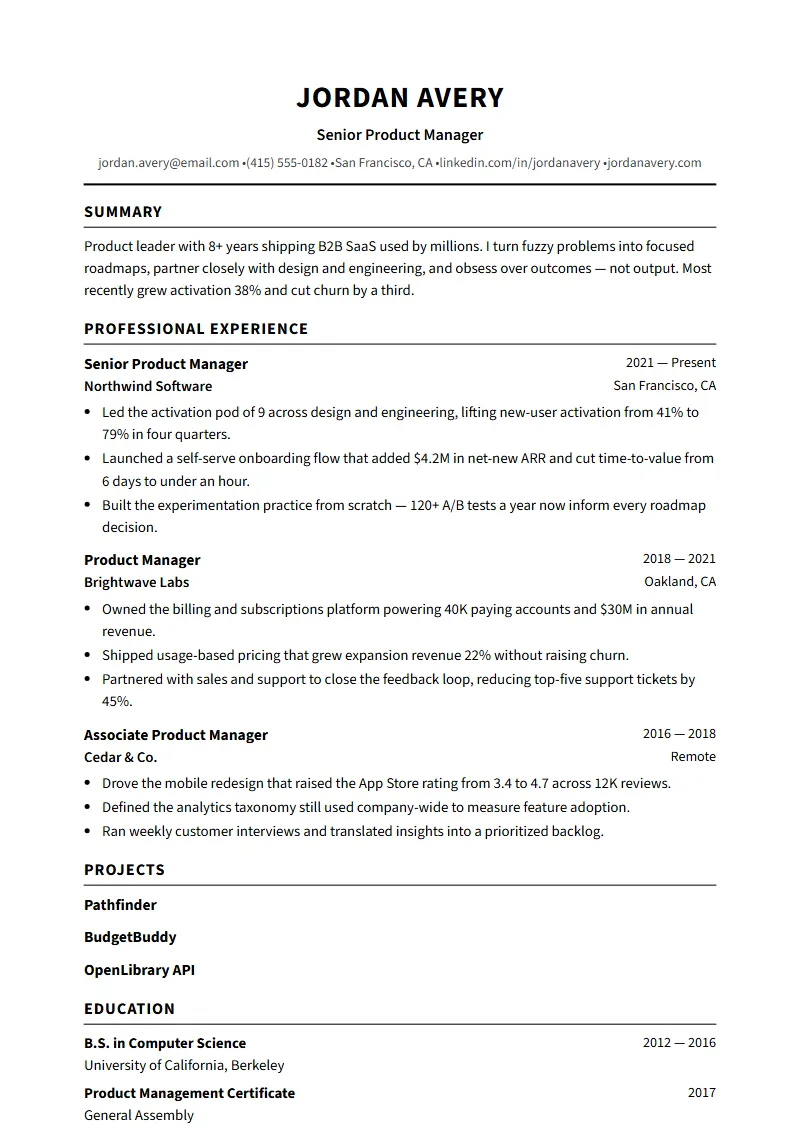
Speech-Language Pathologist resume summary example
Three to four sentences at the top of the page, written in the first person without saying “I”. Rewrite it for every application — the summary is the cheapest place to show you read the job description.
9 speech-language pathologist resume bullet points you can adapt
Copy any of these and replace the specifics with your own. The numbers here are realistic examples, not claims to borrow — swap in what actually happened, because you will be asked about every figure on your resume.
- Manage a daily caseload of 12–14 patients in a 300-bed acute care hospital, covering dysphagia, cognitive-communication, aphasia, and motor speech disorders.
- Perform and interpret roughly 200 modified barium swallow studies annually alongside radiology, translating findings into diet recommendations and compensatory strategies.
- Developed a nurse-administered dysphagia screening protocol adopted hospital-wide; aspiration-pneumonia readmissions fell 19% over the following year.
- Carry a school caseload of 55 students across 3 buildings, writing and defending IEP goals and maintaining 100% compliance with evaluation timelines.
- Evaluate and treat trach and ventilator-dependent patients, including Passy-Muir valve trials and coordination with respiratory therapy on weaning readiness.
- Implement AAC systems for 18 non-verbal students, from low-tech boards to dedicated eye-gaze devices, and train teaching staff and families on daily use.
- Deliver LSVT LOUD protocol for Parkinson's patients, with 14 of 16 participants maintaining vocal intensity gains at 6-month follow-up.
- Supervise 6 clinical fellows and graduate student clinicians, signing off on ASHA supervision requirements and evaluation competencies.
- Maintain 92% productivity in a skilled nursing setting while keeping documentation same-day and denial rates under 2%.
ATS keywords for this role
Applicant tracking systems match literal strings. Work the ones that genuinely apply to you into your summary, skills section, and bullets — and never into white text or a hidden block, which every modern system detects and most employers treat as disqualifying.
Section-by-section breakdown
State CCC and CF status without ambiguity
If you hold the CCC, give the ASHA number. If you are in your Clinical Fellowship, write 'CF-SLP' with your expected completion date and your supervisor's setting. Ambiguity here is read as the less favourable interpretation, every time.
Match the setting's vocabulary
Schools want IEPs, RTI/MTSS, caseload size, and Medicaid billing. Medical settings want MBSS, FEES, trach and vent, and productivity percentages. The same experience needs different framing, and a school-flavoured resume sent to a hospital reads as unprepared.
Name your assessments and protocols
CELF-5, GFTA-3, PPVT-5, MBSImP, VitalStim, LSVT LOUD, PROMPT. These are concrete ATS keywords and they let a clinical director calibrate your depth in a way that 'evaluation and treatment' never will.
Counting your clinical hours
Supervised clinical hours are real, documented patient care and belong on the resume as experience entries — facility, unit, hours, patient population, and the skills you performed. Formatting them as a footnote under Education is the most common way strong candidates in this field undersell themselves.
Be precise about what you performed independently versus observed or assisted with. Preceptors and clinical supervisors find out in the first week, and overstating here damages your standing far more than a shorter list would have.
Core skills for this role
A human reviewer scans this section to decide whether to read the rest. Keep it to the skills you would be comfortable being interviewed on in depth.
Mistakes that sink speech-language pathologist resumes
These are the failure modes specific to this role — not general resume advice you have already read a dozen times.
- Writing 'provided speech therapy' without disorder areas, when dysphagia and AAC in particular are separately hired specialisations.
- Leaving CF status unclear, which a hiring manager will resolve pessimistically rather than by calling to ask.
- Omitting caseload size and setting, the two numbers that tell a director whether you can carry their workload.
- Using school vocabulary for medical roles or vice versa — the same clinical work framed for the wrong audience.
- Skipping productivity percentages in SNF and rehab settings, where they are the metric management is actually evaluated on.
Frequently asked questions
Related resume examples
Build your speech-language pathologist resume
Start from an ATS-safe template and write your real experience into it. Nothing here invents an employer, a title, or a number — the live ATS score just tells you what the job is looking for.