Occupational Therapist Resume Example & Guide
A real example, 9 bullet points you can copy, salary ranges, and the specific things that get occupational therapist resumes rejected.
Occupational therapy resumes have to fight a specific confusion: many reviewers outside the profession do not immediately distinguish OT from PT. The clearest resumes lean into what is distinctly occupational — ADL independence, cognitive and perceptual retraining, adaptive equipment, home modification, and return to meaningful activity.
Setting is the primary sort. Acute care, inpatient rehab, skilled nursing, school-based, hand therapy, and mental health OT are distinct practices with different caseloads and documentation systems, and hiring is setting-specific.
Functional independence is your outcome currency. FIM score changes, discharge disposition, and ADL independence levels are concrete, comparable, and align exactly with how facilities are reimbursed and evaluated.
What hiring managers look for in a occupational therapist resume
- State OT license and NBCOT certification
- Setting and population, stated plainly
- Caseload and productivity expectations met
- Functional outcomes: FIM change, independence level, discharge destination
- Specialty credentials — CHT, SIPT, LSVT, assistive technology
Certifications and licences for occupational therapist roles
List these near the top of your resume. In this field they are eligibility requirements, not accomplishments — a recruiter cannot advance you without them.
- OT License (state, number, expiration)
- NBCOT — OTR certification
- CHT — Certified Hand Therapist
- SIPT / sensory integration certification
- BLS
Occupational Therapist salary range
Approximate US ranges for guidance when you are setting expectations or preparing to negotiate. Actual pay varies considerably by city, employer size, and industry.
Entry
$70K – $84K
0–2 years
Mid
$84K – $98K
3–7 years
Senior
$98K – $120K
8+ years
Occupational Therapist resume example
A Harbor layout filled with sample content. Every template on NavPeer is built to parse cleanly through applicant tracking systems — no text boxes, no sidebars that scramble your work history.
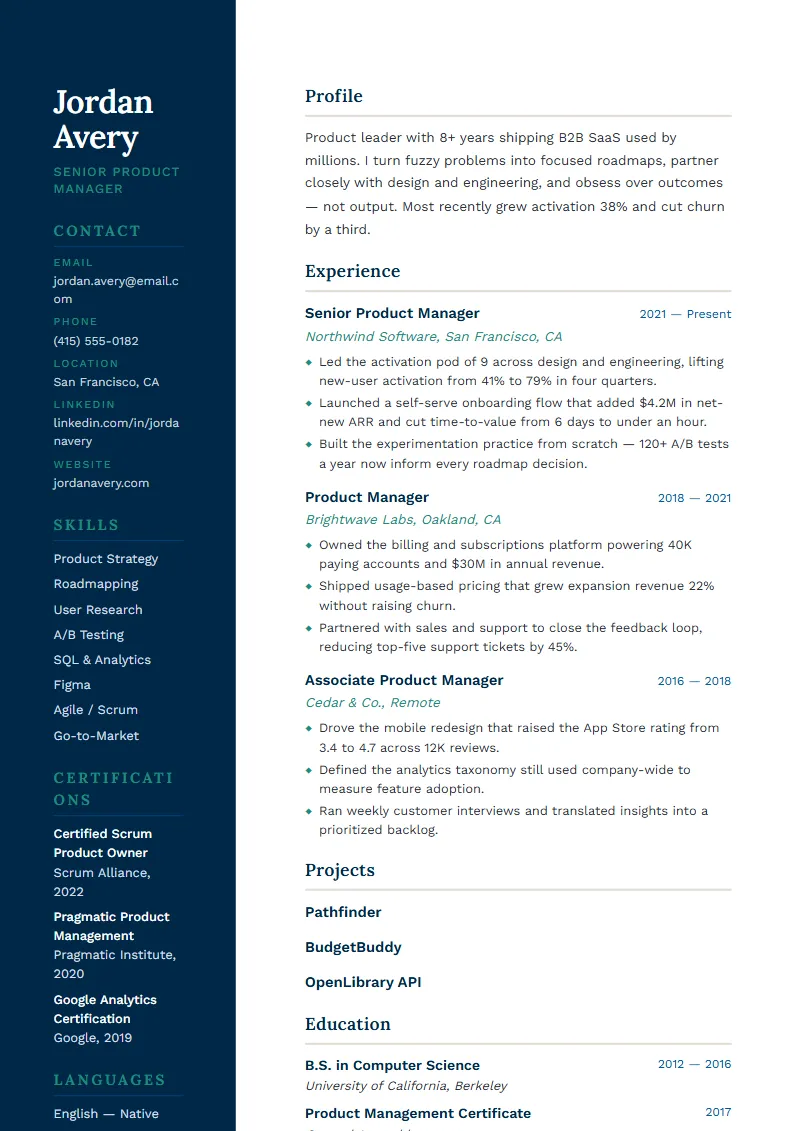
Occupational Therapist resume summary example
Three to four sentences at the top of the page, written in the first person without saying “I”. Rewrite it for every application — the summary is the cheapest place to show you read the job description.
9 occupational therapist resume bullet points you can adapt
Copy any of these and replace the specifics with your own. The numbers here are realistic examples, not claims to borrow — swap in what actually happened, because you will be asked about every figure on your resume.
- Treat 10–12 patients daily on a 30-bed inpatient rehabilitation unit, primarily stroke, TBI, and post-surgical orthopaedic populations.
- Achieve an average 24-point FIM self-care gain per admission across the caseload, above the unit average of 19.
- Established a pre-discharge home assessment programme; discharge-to-home rate for my caseload rose from 68% to 79% over 12 months.
- Fabricate custom static and dynamic splints for post-surgical hand patients, averaging 15 fabrications per month with documented fit revisions under 8%.
- Deliver cognitive and perceptual retraining for stroke and TBI patients, using standardised assessment to set measurable functional goals.
- Train caregivers on transfer technique, adaptive equipment, and home safety before every discharge, cutting 30-day readmissions in my caseload 18%.
- Evaluate and recommend adaptive equipment and durable medical equipment, coordinating with case management for authorisation before discharge.
- Supervise 2 COTAs and precept 3 OT students per year on Level II fieldwork placements.
- Serve on the unit's falls committee, contributing the functional-mobility screening now used at every admission.
ATS keywords for this role
Applicant tracking systems match literal strings. Work the ones that genuinely apply to you into your summary, skills section, and bullets — and never into white text or a hidden block, which every modern system detects and most employers treat as disqualifying.
Section-by-section breakdown
Emphasise what is distinctly occupational
ADLs, cognition, adaptive equipment, home modification, and return to meaningful roles. It differentiates you from PT in the reviewer's mind and describes the actual value you add.
Use functional outcome data
FIM change, independence levels, discharge destination. These map directly to how facilities are reimbursed and evaluated, which makes them persuasive rather than merely descriptive.
Name the setting and population
School-based, hand therapy, acute care, and SNF practice differ enormously. Hiring is setting-specific and the reviewer is matching to theirs.
Counting your clinical hours
Supervised clinical hours are real, documented patient care and belong on the resume as experience entries — facility, unit, hours, patient population, and the skills you performed. Formatting them as a footnote under Education is the most common way strong candidates in this field undersell themselves.
Be precise about what you performed independently versus observed or assisted with. Preceptors and clinical supervisors find out in the first week, and overstating here damages your standing far more than a shorter list would have.
Core skills for this role
A human reviewer scans this section to decide whether to read the rest. Keep it to the skills you would be comfortable being interviewed on in depth.
Mistakes that sink occupational therapist resumes
These are the failure modes specific to this role — not general resume advice you have already read a dozen times.
- Bullets that could equally describe a physical therapist, which wastes the distinctiveness of the profession.
- No functional outcomes, leaving effectiveness unevidenced.
- Omitting caregiver education, which is a large fraction of the role and directly affects readmissions.
- Leaving off specialty credentials like CHT that meaningfully expand your options.
- Generic 'improved patient independence' without the measure or the baseline.
Frequently asked questions
Related resume examples
Build your occupational therapist resume
Start from an ATS-safe template and write your real experience into it. Nothing here invents an employer, a title, or a number — the live ATS score just tells you what the job is looking for.