Respiratory Therapist Resume Example & Guide
A real example, 9 bullet points you can copy, salary ranges, and the specific things that get respiratory therapist resumes rejected.
Respiratory therapy resumes live or die on two letters: CRT or RRT. Both are NBRC credentials, but they are not interchangeable to a hiring manager — most hospital postings now require the RRT outright, and ICU and transport roles will not consider a CRT. Put the credential, the NBRC number, and your state license in the header, because a recruiter scanning fifty applications is sorting on that line before anything else.
After the credential, the screen is about equipment and acuity. Ventilator management is the core of the job, and naming the specific ventilators you have run — Servo-i, Puritan Bennett 840, Hamilton G5, Dräger — does more than any adjective. Add the modes you are comfortable with, because APRV and high-frequency oscillatory ventilation signal a very different level of practice from volume control alone.
The third differentiator is the settings you have covered. An RT who has worked adult ICU, NICU, ED, and rapid response is a fundamentally more flexible hire than one who has only done floor therapy, and hospitals staff for that flexibility. Break your coverage out explicitly rather than letting it hide inside a job title.
What hiring managers look for in a respiratory therapist resume
- RRT credential with NBRC number, plus state license and expiration
- Ventilator platforms by name, and the modes you have actually managed
- Unit coverage — adult ICU, NICU, PICU, ED, floor, transport
- ACLS/PALS/NRP depending on the population you will cover
- Intubation assists, extubations, and ABG draws with volume where you have it
Certifications and licences for respiratory therapist roles
List these near the top of your resume. In this field they are eligibility requirements, not accomplishments — a recruiter cannot advance you without them.
- RRT — Registered Respiratory Therapist (NBRC number)
- State respiratory care license (number, expiration)
- ACLS — Advanced Cardiovascular Life Support
- PALS — Pediatric Advanced Life Support
- NRP — Neonatal Resuscitation Program
- ACCS / NPS (specialty credentials)
Respiratory Therapist salary range
Approximate US ranges for guidance when you are setting expectations or preparing to negotiate. Actual pay varies considerably by city, employer size, and industry.
Entry
$56K – $70K
0–2 years
Mid
$70K – $88K
3–7 years
Senior
$88K – $112K
8+ years
Respiratory Therapist resume example
A Anchor layout filled with sample content. Every template on NavPeer is built to parse cleanly through applicant tracking systems — no text boxes, no sidebars that scramble your work history.
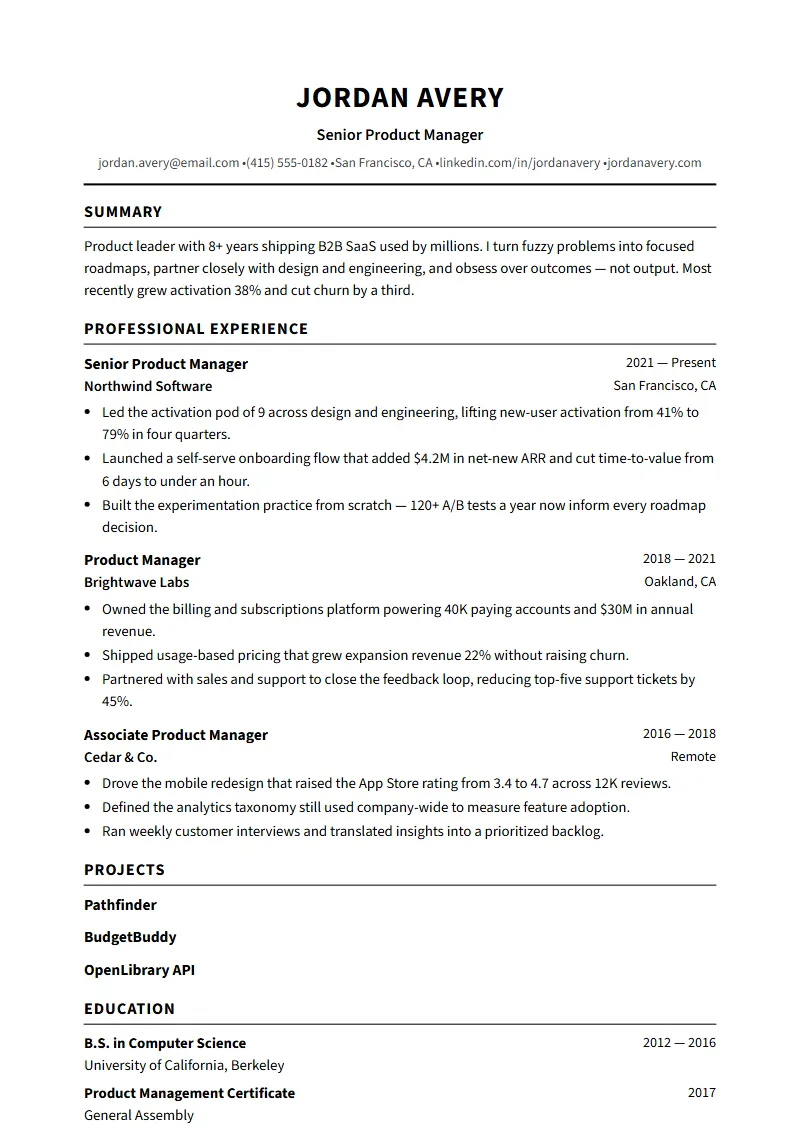
Respiratory Therapist resume summary example
Three to four sentences at the top of the page, written in the first person without saying “I”. Rewrite it for every application — the summary is the cheapest place to show you read the job description.
9 respiratory therapist resume bullet points you can adapt
Copy any of these and replace the specifics with your own. The numbers here are realistic examples, not claims to borrow — swap in what actually happened, because you will be asked about every figure on your resume.
- Manage mechanical ventilation for 8–12 patients per shift across a 24-bed adult ICU, including APRV, pressure control, and prone positioning for ARDS.
- Co-authored a therapist-driven weaning protocol adopted unit-wide; mean ventilator days fell from 6.2 to 4.8 and reintubation rate held under 4%.
- Respond to all codes, rapid responses, and traumas as the airway resource, assisting with roughly 90 intubations per year and performing emergency bag-mask ventilation.
- Draw and interpret 25–30 arterial blood gases per shift, adjusting ventilator settings independently under protocol and escalating to intensivists when indicated.
- Titrate BiPAP and high-flow nasal cannula for COPD and CHF exacerbations in the ED, contributing to a 22% reduction in avoidable intubations over 18 months.
- Cover NICU on rotation, managing surfactant administration and high-frequency oscillatory ventilation for neonates down to 24 weeks gestation.
- Precept respiratory care students from two accredited programmes, supervising roughly 400 clinical hours annually.
- Perform and interpret bedside pulmonary function testing and six-minute walk tests for pre-operative and pulmonary rehab referrals.
- Serve on the ventilator-associated pneumonia committee; unit VAP rate dropped from 1.8 to 0.6 per 1,000 ventilator days after standardising oral care and head-of-bed compliance.
ATS keywords for this role
Applicant tracking systems match literal strings. Work the ones that genuinely apply to you into your summary, skills section, and bullets — and never into white text or a hidden block, which every modern system detects and most employers treat as disqualifying.
Section-by-section breakdown
Lead with RRT, not RT
The credential is the screen. Write it as 'Registered Respiratory Therapist (RRT)' with your NBRC number and state license, in the header. If you hold the CRT only, say so plainly and note whether your RRT exam is scheduled — hiring managers respect the timeline and distrust ambiguity.
Name the ventilators
Servo-i, Puritan Bennett 840, Hamilton G5, Dräger Evita. Departments standardise on a platform and a therapist who already knows theirs needs less orientation. This is one of the most commonly parsed keyword sets in respiratory postings.
Break out your unit coverage
Adult ICU, NICU, PICU, ED, floor, transport. Neonatal experience in particular is a specialised, separately-hired skill — if you have it, it should never be buried inside a general hospital job description.
Counting your clinical hours
Supervised clinical hours are real, documented patient care and belong on the resume as experience entries — facility, unit, hours, patient population, and the skills you performed. Formatting them as a footnote under Education is the most common way strong candidates in this field undersell themselves.
Be precise about what you performed independently versus observed or assisted with. Preceptors and clinical supervisors find out in the first week, and overstating here damages your standing far more than a shorter list would have.
Core skills for this role
A human reviewer scans this section to decide whether to read the rest. Keep it to the skills you would be comfortable being interviewed on in depth.
Mistakes that sink respiratory therapist resumes
These are the failure modes specific to this role — not general resume advice you have already read a dozen times.
- Writing 'RT' when you hold the RRT. You are giving away the single credential the posting screens on.
- Listing 'ventilator management' with no platform, mode, or patient volume behind it — the phrase appears on every RT resume in the stack.
- Omitting NICU or transport experience because it was only a rotation. Both are separately staffed and separately valued.
- Treating ABGs as a duty rather than a number. Draw volume and independent interpretation under protocol are real differentiators.
- Leaving out protocol or committee work. Therapist-driven protocols are how RTs demonstrate clinical autonomy, which is exactly what senior roles hire for.
Frequently asked questions
Related resume examples
Build your respiratory therapist resume
Start from an ATS-safe template and write your real experience into it. Nothing here invents an employer, a title, or a number — the live ATS score just tells you what the job is looking for.