Athletic Trainer Resume Example & Guide
A real example, 9 bullet points you can copy, salary ranges, and the specific things that get athletic trainer resumes rejected.
Athletic training resumes have a persistent credibility problem: the public confuses the job with personal training, and resumes that lean on 'fitness' vocabulary make it worse. You are a licensed healthcare provider working under a physician's direction. Lead with the BOC credential and state licensure, and use clinical language — evaluation, differential, rehabilitation protocol, return-to-play — throughout.
The setting is the second screen, and the settings are genuinely different jobs. A high school AT is often the sole provider, handling everything from emergency action planning to parent communication. A Division I AT works inside a sports medicine team with physicians and physical therapists. Industrial and performing-arts ATs treat entirely different injury patterns. Name your setting, sports, and athlete count for every position.
The most underused material on an AT resume is outcomes. You already track injury rates, time-loss days, and return-to-play timelines. Concussion protocol compliance, emergency action plan drills, and pre-participation screening throughput are all countable. A resume with those numbers stands out immediately against a field describing taping and water breaks.
What hiring managers look for in a athletic trainer resume
- BOC certification and state licensure, with numbers and expiration
- Setting and sports covered, with athlete headcount per season
- Emergency action planning, spine boarding, and AED/emergency response readiness
- Concussion management under a named protocol, and return-to-play decision-making
- Rehabilitation programme design and documentation, plus EMR by name
Certifications and licences for athletic trainer roles
List these near the top of your resume. In this field they are eligibility requirements, not accomplishments — a recruiter cannot advance you without them.
- ATC — BOC certification (number, expiration)
- State athletic training license or registration
- CPR/AED for the Professional Rescuer
- EMT or Emergency Medical Responder (setting-dependent)
- CSCS — Certified Strength and Conditioning Specialist
- Graston, dry needling, or manual therapy certification (state-dependent)
Athletic Trainer salary range
Approximate US ranges for guidance when you are setting expectations or preparing to negotiate. Actual pay varies considerably by city, employer size, and industry.
Entry
$46K – $56K
0–2 years
Mid
$56K – $70K
3–7 years
Senior
$70K – $92K
8+ years
Athletic Trainer resume example
A Harbor layout filled with sample content. Every template on NavPeer is built to parse cleanly through applicant tracking systems — no text boxes, no sidebars that scramble your work history.
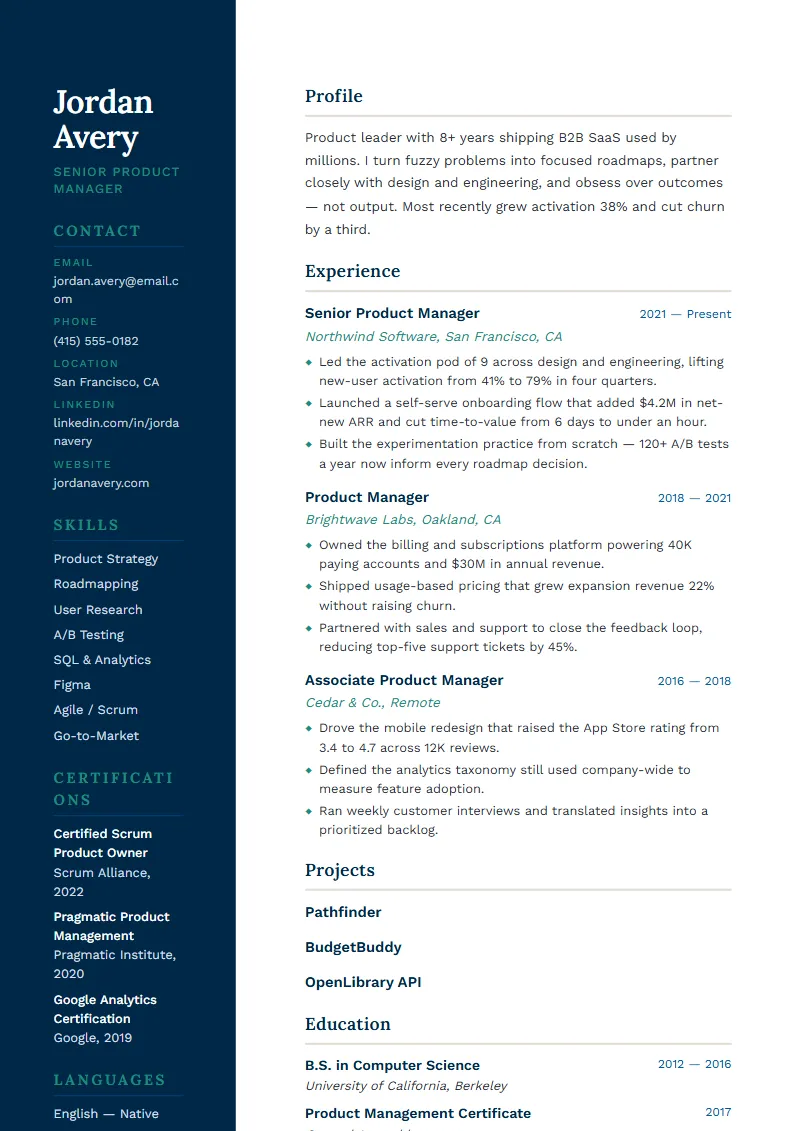
Athletic Trainer resume summary example
Three to four sentences at the top of the page, written in the first person without saying “I”. Rewrite it for every application — the summary is the cheapest place to show you read the job description.
9 athletic trainer resume bullet points you can adapt
Copy any of these and replace the specifics with your own. The numbers here are realistic examples, not claims to borrow — swap in what actually happened, because you will be asked about every figure on your resume.
- Serve as sole athletic trainer for 14 varsity and junior varsity sports covering roughly 420 athletes, providing evaluation, treatment, and event coverage year-round.
- Manage 60+ concussions across three seasons under a SCAT5-based protocol with graduated return-to-play and return-to-learn, recording zero same-day return violations.
- Rebuilt the school's emergency action plan and ran quarterly drills with coaching staff and EMS; venue-specific plans now posted at all 6 competition sites.
- Design and progress rehabilitation programmes for 80–100 active injuries per season, coordinating with team physicians and referring physical therapists.
- Reduced time-loss days per contact injury by 26% over three seasons through a pre-season neuromuscular screening and ACL prevention programme.
- Coordinate pre-participation physical examinations for 420 athletes annually, managing physician volunteers, screening flow, and clearance documentation.
- Provide on-field emergency care including spine boarding, splinting, and AED response; maintain and inventory all emergency equipment across venues.
- Supervise 4 athletic training students on clinical rotation, covering evaluation technique, documentation standards, and event coverage responsibilities.
- Document all encounters in SportsWare, producing injury-surveillance reports that informed the district's turf replacement decision.
ATS keywords for this role
Applicant tracking systems match literal strings. Work the ones that genuinely apply to you into your summary, skills section, and bullets — and never into white text or a hidden block, which every modern system detects and most employers treat as disqualifying.
Section-by-section breakdown
Lead with ATC and state licensure
BOC certification number and state license with expiration, in the header. Athletic training is licensed or regulated in nearly every state, and leading with the credential also separates you immediately from personal-training applicants who apply to the same postings.
Give the setting its numbers
Sports covered, athlete headcount, and whether you were sole provider or part of a team. Sole coverage of 400 athletes across 14 sports is a fundamentally different job from one sport inside a staffed sports medicine department, and only the numbers show it.
Make concussion management explicit
Name the protocol, the assessment tools, and the return-to-play and return-to-learn process. It is the highest-liability part of the role and the thing an athletic director will ask about first.
Counting your clinical hours
Supervised clinical hours are real, documented patient care and belong on the resume as experience entries — facility, unit, hours, patient population, and the skills you performed. Formatting them as a footnote under Education is the most common way strong candidates in this field undersell themselves.
Be precise about what you performed independently versus observed or assisted with. Preceptors and clinical supervisors find out in the first week, and overstating here damages your standing far more than a shorter list would have.
Core skills for this role
A human reviewer scans this section to decide whether to read the rest. Keep it to the skills you would be comfortable being interviewed on in depth.
Mistakes that sink athletic trainer resumes
These are the failure modes specific to this role — not general resume advice you have already read a dozen times.
- Using fitness and conditioning vocabulary that makes a licensed clinician read like a personal trainer.
- Describing coverage without athlete counts or sports, which hides the actual scale of the job.
- Omitting emergency action planning and spine boarding — the low-frequency, high-stakes competencies that hiring committees screen hardest on.
- Listing modalities as a skills dump with no rehabilitation outcomes or return-to-play timelines attached.
- Leaving out documentation systems. Injury surveillance data is increasingly how athletic training programmes justify their budgets.
Frequently asked questions
Related resume examples
Build your athletic trainer resume
Start from an ATS-safe template and write your real experience into it. Nothing here invents an employer, a title, or a number — the live ATS score just tells you what the job is looking for.